2025 Federal Medical Cannabis Policy: What Changed & What 2026 Will Mean for Patient Access
 In 2025, the federal government finally admitted what patients have known for decades: cannabis has medical value. But acknowledgment is not access—and recognition without protection is not reform.
This year delivered a mix of long-overdue clarity, dangerous misconceptions, and hard deadlines that will directly affect millions of patients who rely on cannabis and cannabinoid therapies. As we move into 2026, the stakes are no longer theoretical.
Below is a review of federal policy developments in 2025—and what patients, advocates, and policymakers will confront next.
The Hemp Policy Clean-up
For years, Congress avoided defining what “hemp-derived cannabinoid products” actually are. That omission in the 2018 Farm Bill created a legal gray zone that allowed intoxicating hemp products to flood the market—often unregulated, inconsistently labeled, and difficult for states to control.
In November 2025, that changed.
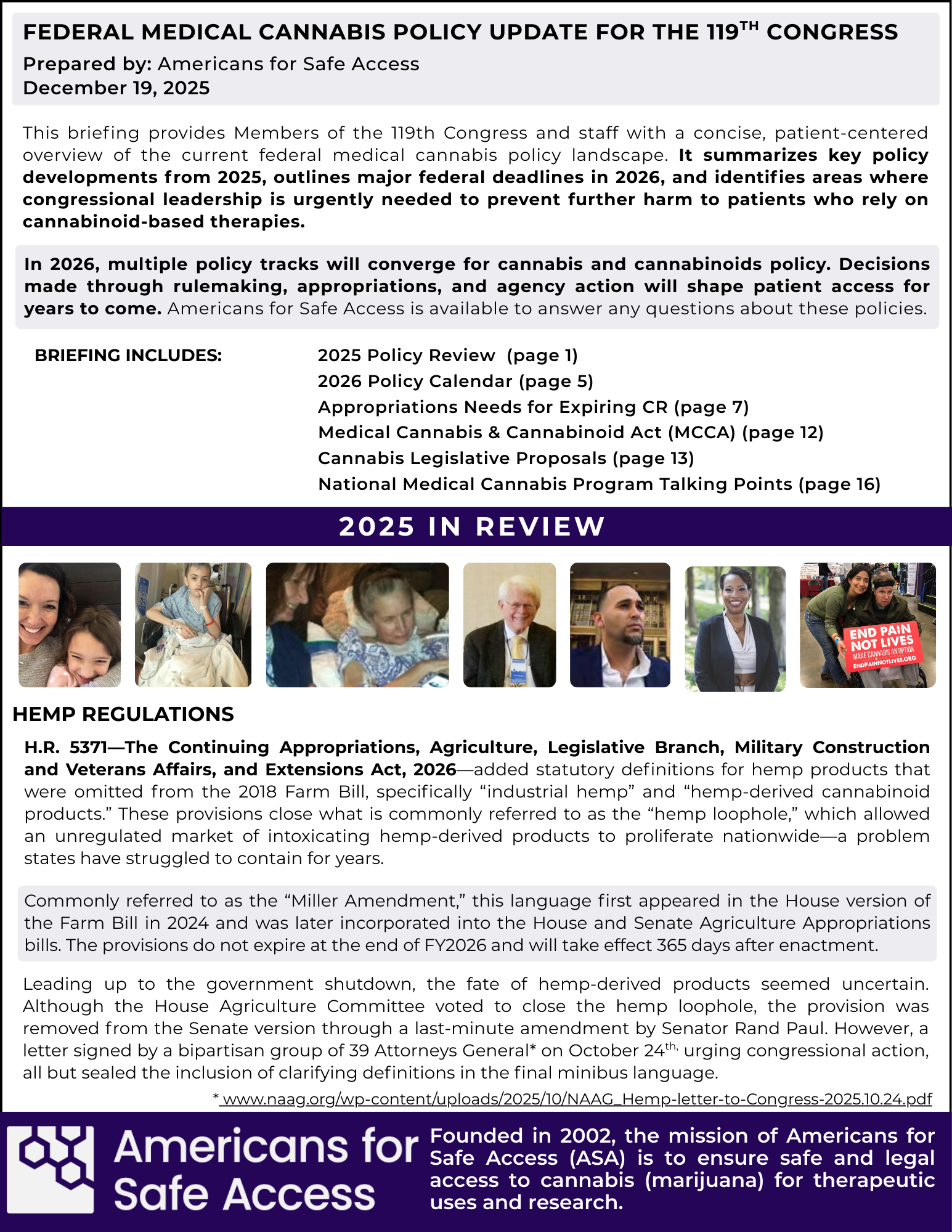
The FY2026 Agriculture provisions in H.R. 5371 added statutory definitions for industrial hemp, hemp-derived cannabinoid products, and intermediate hemp-derived cannabinoid products. This language—often called the Miller Amendment—permanently closes the so-called “hemp loophole.” The provisions do not expire and will take effect on November 11, 2026.
The law tightens the definition of hemp by shifting to a total THC standard that captures THCa and all detectable THC compounds. It imposes a strict 0.4 mg THC per container cap, bans synthetic cannabinoids, restricts seeds capable of producing plants over 0.3% THC, and gives regulators clearer authority to enforce these limits. This was not a theoretical cleanup. A bipartisan letter from 39 state Attorneys General urging Congress to act effectively sealed the outcome.
What This Means for Patients
For millions of patients, especially those in states without functional medical cannabis programs, full-spectrum hemp products have been a lifeline. These aren’t casual purchases. They’re used to manage seizures, cancer symptoms, chronic pain, PTSD, autism, and rare diseases.
Many patients were told—often in good faith—that these products were legal. Meanwhile, the DEA consistently warned that many were not. Seven years of mixed messaging have now collided with statutory reality.
The clock is ticking. Without congressional fixes or transition pathways, access for these patients will change in 2026—and not necessarily for the better.
Trump’s Executive Order: Acknowledgment Without Access
On December 18, 2025, President Trump signed an Executive Order titled “Increasing Medical Marijuana and Cannabidiol Research.” The Order directs DOJ to expedite completion of the cannabis rescheduling process, instructs HHS to develop real-world evidence models for cannabinoid therapies, and signals interest in improving access to full-spectrum CBD—while restricting products that pose health risks.
The Order did not reschedule cannabis, legalize medical cannabis, create patient protections, or establish federal access. Despite headlines to the contrary, cannabis remains Schedule I unless and until DOJ and DEA complete the formal rescheduling process initiated under the Biden Administration.
Rescheduling Is Not Guaranteed
That process stalled just days before a scheduled Administrative Law Judge hearing due to a procedural appeal. The Attorney General now has several options—each legally and politically risky. Compounding the uncertainty, the House version of the FY2026 Commerce-Justice-Science (CJS) Appropriations bill included language that would block the DOJ from completing the Rescheduling process. If the language survives, that path to rescheduling stops—Executive Order or not.
Misconceptions about the Impact of Schedule III
Cannabis moving out of Schedule will be a significant milestone, but Schedule III will not mean relief for patients. Schedule III does not legalize medical cannabis, protect patients from discrimination, integrate cannabis into Medicare, Medicaid, VA care, or hospitals, or create prescriptions, coverage, or federal recognition of state programs.
Cannabis would still be illegal outside tightly controlled federal channels. State medical programs would remain legally precarious, protected only by the annually renewed CJS medical cannabis amendment. Without that protection, patients and providers risk arrest and prosecution again.
Another persistent misconception: that Schedule III “fixes” cannabis taxation. Rescheduling would remove the automatic application of IRS Section 280E, but it does not guarantee deductions. Other tax laws still apply to activities that remain federally illegal, and Supreme Court precedent is clear: income may be taxable even when expenses are not deductible.
Without a lawful federal medical framework, tax uncertainty remains.
2026: The Year of Federal Cannabis Policy Reckoning
In 2026, hemp restrictions take effect, rescheduling could advance, and patient protections must be renewed yet again. This is not abstract policy. It is about whether people managing serious medical conditions will retain access to treatments that work for them without risking their housing, benefits, or freedom.
Patients have waited long enough. Now Congress must decide if support for “medical cannabis” is just a talking point—or a commitment to a healthcare tipping point. This is where patient advocacy is required.
 Key Federal Policy Dates in 2026
January 26, 2026: An Opening to Insurance Coverage
CMS’s public comment process on Medicare Advantage supplemental benefits will help determine whether medical cannabis remains excluded by default or evaluated based on legality and medical use. Medicare sets norms across the healthcare system; what CMS does here influences hospitals, insurers, and long-term care nationwide.
January 30, 2026: FY2026 Continuing Resolutions Expire
Congress must decide whether DOJ and DEA are allowed to complete rescheduling, whether state medical cannabis programs retain federal protection, and whether HHS has funding to carry out research and healthcare integration work tied to the Executive Order.
February 2026: FDA Weighs In
Under H.R. 5371, FDA must publish cannabinoid lists and definitions that will shape which products survive the hemp transition, how “intoxicating” is defined, and whether patients retain access to non-intoxicating and full-spectrum products.
September 30, 2026: FY2027 Appropriations Deadline
FY2027 appropriations are due. Medical cannabis protections must be renewed. Any progress made earlier in the year can be undone.
November 11, 2026: The Hemp Line in the Sand
New statutory definitions become enforceable. Total THC thresholds apply. Synthetic cannabinoids are banned. Container limits are enforced. This is when access actually changes—especially for patients relying on hemp-derived cannabinoid therapies.
Read ASA's December 2025 Federal Medical Cannabis Policy Update for the 119th Congress
Calling All Patient Advocates: Take the Medical Cannabis Action Pledge
Success in 2026 depends on whether patient voices are organized, visible, and ready when decisions are made.
The calendar is set. Deadlines are known. What remains undecided is whether patients will be present in rulemakings, congressional offices, local media, and the public record when policy choices are finalized.
The Medical Cannabis Action Pledge is how patient advocates prepare for those moments. It connects individuals to coordinated, time-sensitive actions so patients can act before access is lost—not after.
 By taking the pledge, advocates commit to actions such as:
- Rapid outreach to policymakers
- Amplifying patient-centered information
- Media response and public education
- Local distribution of advocacy materials
- Speaking engagements and presentations
- Network mobilization when fast action is needed
Information and commitments can be updated at any time. What matters is readiness.
Recognition is not protection. Action is.
2026 is the year patients must be organized, visible, and impossible to ignore.
Join Medical Cannabis Organizing in 2026. Take the Medical Cannabis Action Pledge Now!
Medical Cannabis Organizing in 2026 (Dec 2025): Watch the virtual gathering (webinar)

Share this page