Emergency Briefing: The Minibus, Hemp & Patients
 Experts Discuss How Congress Clarifying Hemp Laws Impact Patients & the Future Access to Medicinal Cannabis
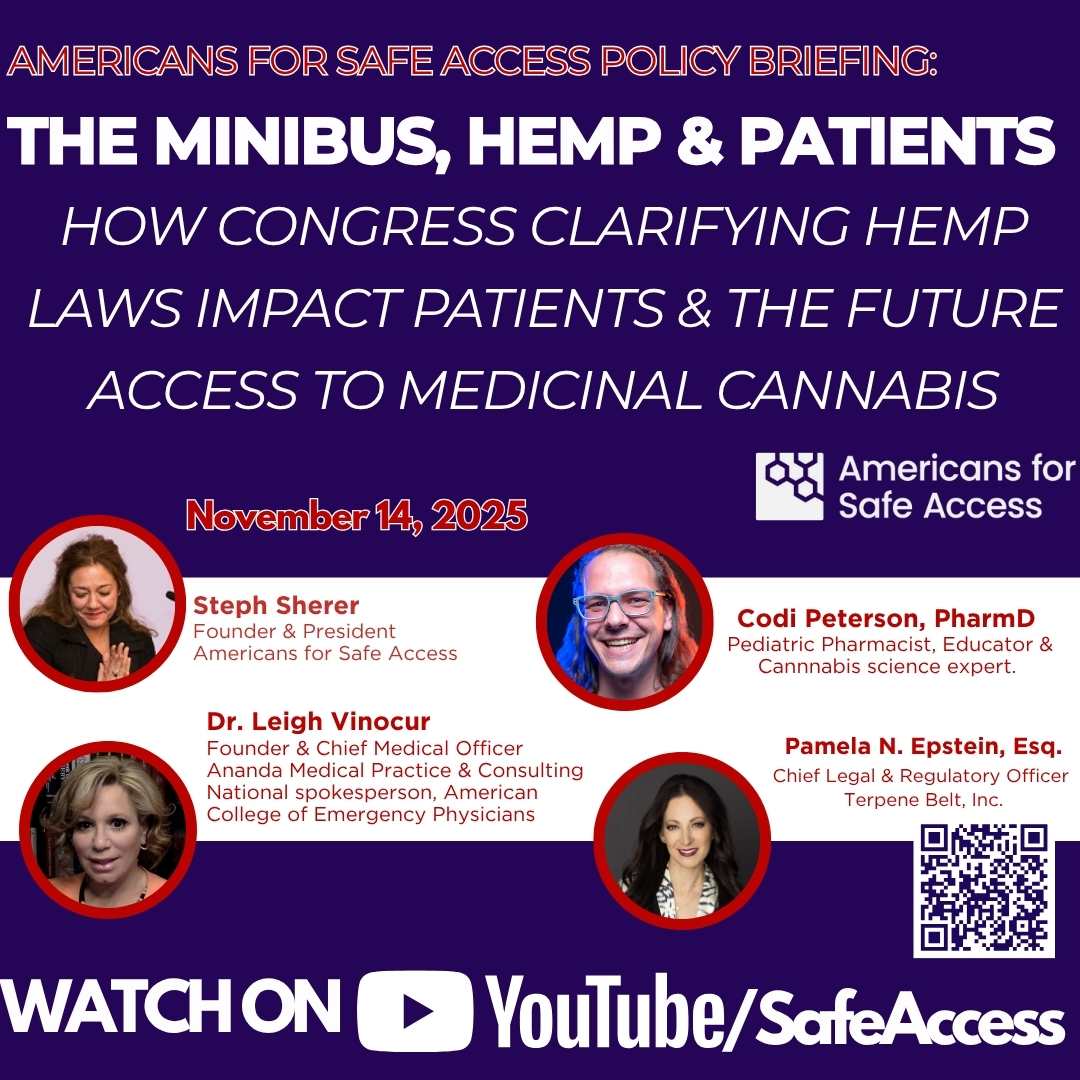
Washington, D.C. — Americans for Safe Access (ASA), the nation’s largest patient-focused medical cannabis organization, will host a briefing on November 14 in response to Congress clarifying hemp definitions in the recent “minibus” spending bill, H.R. 5371—The Continuing Appropriations, Agriculture, Legislative Branch, Military Construction and Veterans Affairs, and Extensions Act, 2026.
Now Available on YouTube!
Often framed as a “ban on hemp,” the bill added definitions for hemp products that were left out of the 2018 Hemp Bill, specifically “industrial hemp” products and “hemp-derived" products (see language at the end of this release). The provisions close what is often referred to as a "loophole" that allowed an unregulated market of intoxicating hemp products to proliferate — a problem states have struggled to control for years. Also referred to as the “Miller Amendment,” the language, first seen in last year’s Farm Bill draft, was included in the House version of the Agriculture Appropriations Bill. These provisions will take effect 365 days after passage.
For many patients, however, this has come as a shock. Hemp-derived “full-spectrum” products — often purchased online — have become the primary source of cannabinoid therapeutics, especially in states without functioning medical cannabis programs or in markets where patients must compete with adult-use consumers for "shelf space". Although manufacturers have long assured patients that these products were legal, the DEA has maintained its position on their illegality since their arrival on the market, creating 7 years of confusion, mixed messaging, and inconsistent enforcement.
“From a pharmacological standpoint, the ‘hemp products’ patients are taking to treat medical conditions are medical cannabis,” said Dr. Codi Peterson, PharmD, pediatric pharmacist and cannabis science educator. “Patients chose hemp products because they were told they were legal — and like medical cannabis, they worked. The hemp market filled a gap that our medical cannabis laws left wide open. These changes highlight how urgently we need consistent, science-based medical access pathways — not patchwork solutions driven by politics.”
Leading up to the government shutdown, the fate of hemp-derived products seemed uncertain. Although the House Agriculture Committee voted to "close the hemp loophole", the Senate version removed the language at the last minute through an amendment by Senator Rand Paul. However, a letter signed by a bipartisan group of 39 Attorneys General on October 24th, urging congressional action, all but sealed the inclusion of clarifying definitions in the final minibus language. 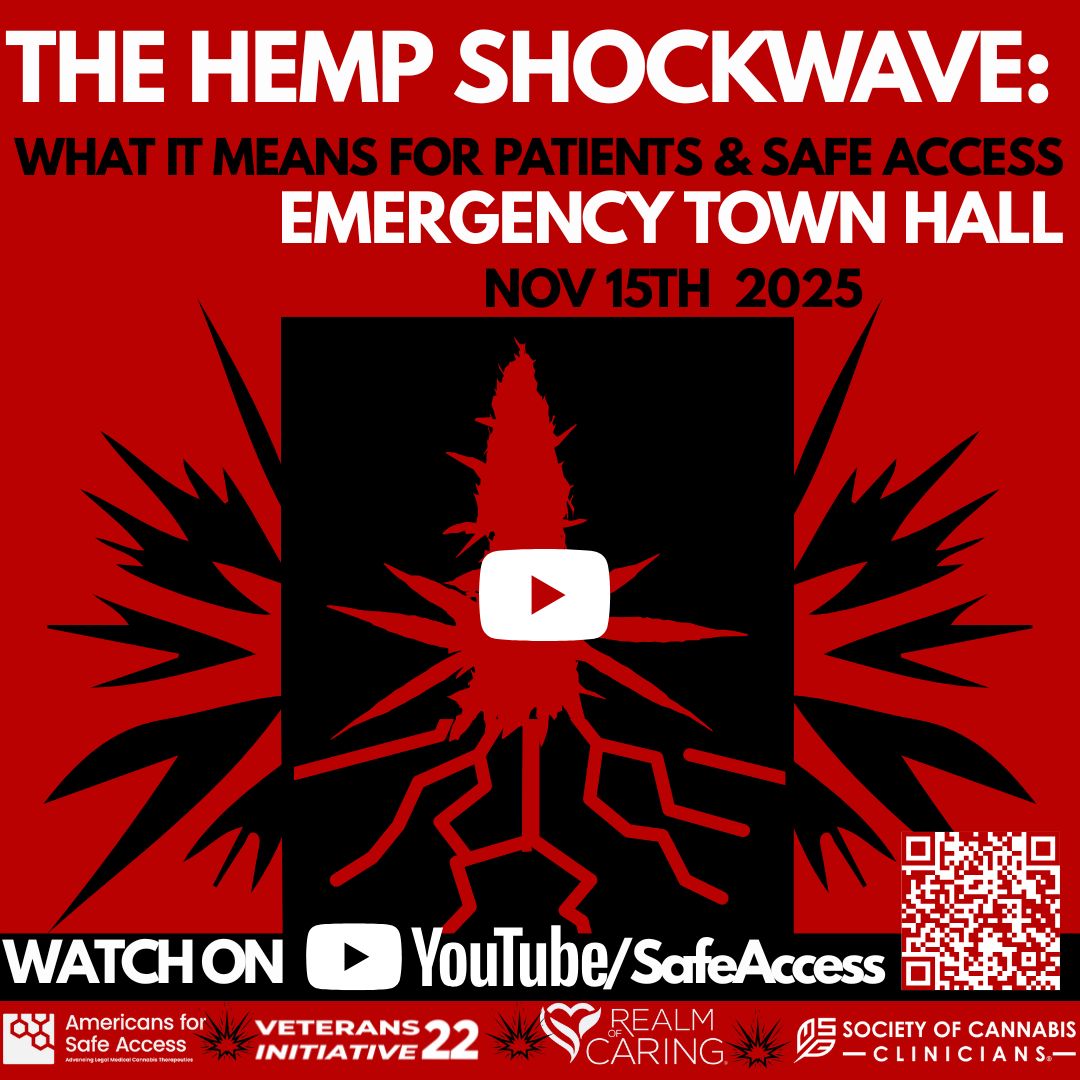
While much of the news is focused on the impact on the intoxicating hemp market, many patient communities are scrambling to find direction in the face of these new policy realities. Subsequently, on Saturday, November 15th, Americans for Safe Access (ASA), Realm of Caring, and Veterans Initiative 22 held an Emergency Town Hall: “The Hemp Shockwave: What It Means for Patients & Safe Access,” to answer patients’ questions, discuss real-world impacts, and outline actionable advocacy strategies to protect safe access to cannabinoid medicines. Now available on YouTube.
“Many patients stopped fighting for medical cannabis access when hemp-derived products became available through mainstream retail,” said Steph Sherer, ASA Founder and Executive Director. “Now millions of Americans are treating serious conditions with ‘full-spectrum hemp’ without realizing they are accessing cannabis medicines through a loophole. As these patients learn that Congress has set an expiration date on this access, advocates must channel their outrage into demanding the medical framework they have always deserved.”
Experts at ASA’s briefing will clarify what these policies actually mean for patients today, tomorrow, and a year from now — and outline urgent policy solutions to protect medical cannabis access at both the state and federal levels.
“Without clear patient protections, millions risk losing access to products they thought they could depend on,” added Dr. Leigh Vinocur, cannabis expert and emergency physician. “It’s time for lawmakers to put patients first and create a coherent, federally recognized medical cannabis framework that supports safety, transparency, and therapeutic integrity. Also, states should act now to ensure patients can find these products safely through regulated medical cannabis programs rather than unregulated or disappearing markets.”
In addition to patient implications, experts will examine how the hemp and cannabis markets arrived at this point and why it is time for federal policymakers to address medical cannabis access directly.
“Congress’ clarification sheds light on the exploited line between hemp and medical cannabis — and in doing so, exposes the cracks in our policy foundation,” said Pamela N. Epstein, Esq., Chief Legal and Regulatory Officer at Terpene Belt. “Unfortunately, there is a real disconnect between soundbites and federal lobbying directives for many of the companies in this market.”
Attendees will learn:
The legislative history from the 2018 Farm Bill to the 2025 minibus and implications for state and federal reform.
What happened on Capitol Hill — from appropriations debates to the final “minibus” version — and how preserving intoxicating hemp was prioritized over patient access.
The pharmacology of hemp-derived products used by patients, the limits of the “perceived” legal hemp market, and gaps in existing medical programs.
The dangers of unregulated markets, steps states can take now to ensure patient access within regulated systems, and federal policy options that will move us toward permanent solutions for medical cannabis access nationwide.
When: Friday, November 14, 1:00 p.m. ET
Where: Virtual briefing — registration required Register here: www.safeaccessnow.org/emergency_briefing_federal_hemp_patients
Who:
Steph Sherer
Founder and Executive Director, Americans for Safe Access
Steph Sherer is a pioneering international leader and expert in medical cannabis patient advocacy. Her personal experience with the therapeutic benefits of cannabis, combined with her background in political organizing, led her to establish ASA in 2002. Under her guidance, ASA has grown into the nation’s largest patient-centered organization dedicated to ensuring access to medical cannabis, bridging gaps in knowledge, policy, and regulation, and promoting its recognition as a legitimate medical therapy.
Codi Peterson, PharmD
Pediatric Pharmacist and Cannabis Science Educator
Dr. Peterson is a clinical pharmacist and educator working to bridge healthcare and cannabis science. He teaches pharmacology at UC Irvine and OCEMT, practices pharmacy in an emergency department, and specializes in evidence-based cannabinoid pharmacology.
Dr. Leigh Vinocur
Emergency Physician and Founder, Ananda Medical Practice and Consulting
A board-certified emergency physician, Dr. Vinocur is a leading expert in medical cannabis science and education. She chairs the Subcommittee on Medical Cannabis Science Training for Healthcare Providers on Maryland’s Cannabis Public Health Advisory Council and serves as a national spokesperson for the American College of Emergency Physicians (ACEP).
Pamela N. Epstein, Esq.
Chief Legal and Regulatory Officer, Terpene Belt
Pamela Epstein leads legal and regulatory strategy at Terpene Belt, overseeing compliance, governance, and governmental affairs. A former two-term President of the California Cannabis Industry Association (CCIA), she has been instrumental in shaping the policy landscape for cannabis and hemp. Epstein also serves on ASTM’s D37 Committee for Cannabis and Hemp and the Food and Drug Law Institute’s Cannabinoid Committee.
AGRICULTURE-FDA MINIBUS
Hemp Provision in Minibus (the black text is from the House version of the Agriculture Appropriations Bill, the red text is language that was added or deleted for the Minibus Bill)
SEC. 781.
Effective 365 days after the enactment of this Act, Section 297A of the Agricultural Marketing Act of 1946 (7 U.S.C. 1639o) is amended—
- by redesignating paragraphs (2) through (6) as paragraphs (4) through (8), respectively; and
- by striking paragraph (1) and inserting the following:
(1) HEMP.—
(A) IN GENERAL.—The term ‘hemp’ means the plant Cannabis sativa L. and any part of that plant, including the seeds thereof and all derivatives, extracts, cannabinoids, isomers, acids, salts, and salts of isomers, whether growing or not, with a total tetrahydrocannabinols concentration (including tetrahydrocannabinolic acid) of not more than 0.3 percent in the plant on a dry weight basis.
(B) INCLUSION.—Such term includes industrial hemp.
(C) EXCLUSIONS.—Such term does not include—
(i) any viable seeds from a Cannabis sativa L. plant that exceeds a total tetrahydrocannabinols concentration (including tetrahydrocannabinolic acid) of 0.3 percent in the plant on a dry weight basis; or
(ii) any intermediate hemp-derived cannabinoid products containing—
(I)cannabinoids that are not capable of being naturally produced by a Cannabis sativa L. plant;
(II) cannabinoids that—
(aa) are capable of being naturally produced by a Cannabis sativa L. plant; and
(bb) were synthesized or manufactured outside the plant; or
(III) quantifiable amounts based on substance, form, manufacture, or article (as determined by the Secretary of Health and Human Services in consultation with the Secretary of Agriculture) of—
(III) more than 0.3 percent combined total of—
(aa) total tetrahydrocannabinols (including tetrahydrocannabinolic acid); and
(bb) any other cannabinoids that have similar effects (or are marketed to have similar effects) on humans or animals as a tetrahydrocannabinol (as determined by the Secretary of Health and Human Services in consultation with the Secretary of Agriculture); or
(iii) any intermediate hemp-derived cannabinoid products which are marketed or sold as a final product or directly to an end consumer for personal or household use; or
(iv) any final hemp-derived cannabinoid products containing—
(I) cannabinoids that are not capable of being naturally produced by a Cannabis sativa L. plant;
(II) cannabinoids that—
(aa) are capable of being naturally produced by a Cannabis sativa L. plant; and
(bb) were synthesized or manufactured outside the plant; or
(III) greater than 0.4 milligrams combined total per container of—
(aa) total tetrahydrocannabinols (including tetrahydrocannabinolic acid); and
(bb) any other cannabinoids that have similar effects (or are marketed to have similar effects) on humans or animals as a tetrahydrocannabinol (as determined by the Secretary of Health and Human Services).
(2) INDUSTRIAL HEMP.—
The term ‘industrial hemp’ means hemp—
(A) grown for the use of the stalk of the plant, fiber produced from such a stalk, or any other non-cannabinoid derivative, mixture, preparation, or manufacture of such a stalk;
(B) grown for the use of the whole grain, oil, cake, nut, hull, or any other non-cannabinoid compound, derivative, mixture, preparation, or manufacture of the seeds of such plant;
(C) grown for purposes of producing microgreens or other edible hemp leaf products intended for human consumption that are derived from an immature hemp plant that is grown from seeds that do not exceed the threshold for total tetrahydrocannabinols concentration specified in paragraph (1)(C)(i);
(D) that is a plant that does not enter the stream of commerce and is intended to support hemp research at an institution of higher education (as defined in section 101 of the Higher Education Act of 1965 (20 U.S.C. 1001)) or an independent research institute; or
(E) grown for the use of a viable seed of the plant produced solely for the production or manufacture of any material described in subparagraphs (A) through (D).
(3) HEMP-DERIVED CANNABINOID PRODUCT.—
(A) IN GENERAL.—The term ‘hemp-derived cannabinoid product’ means any intermediate or final product derived from hemp (other than industrial hemp) that—
(i) contains cannabinoids in any form; and
(ii) is intended for human or animal use through any means of application or administration, such as inhalation, ingestion, or topical application.
(B) The term ‘intermediate hemp-derived cannabinoid product’ means a hemp-derived cannabinoid product which—
(i) is not yet in the final form or preparation marketed or intended to be used or consumed by a human or animal; or
(ii) is a powder, liquid, tablet, oil, or other product form which is intended or marketed to be mixed, dissolved, formulated, or otherwise added to or prepared with or into any other substance prior to administration or consumption.
(C) The term ‘container’ means the innermost wrapping, packaging, or vessel in direct contact with a final hemp-derived cannabinoid product in which the final hemp-derived cannabinoid product is enclosed for retail sale to consumers, such as a jar, bottle, bag, box, packet, can, carton, or cartridge.
(D) The term container excludes bulk shipping containers or outer wrappings that are not essential for the final retail delivery or sale to an end consumer for personal or household use.
(E) EXCLUSION.—Such term does not include a drug that is the subject of an application approved under subsection (c) or (j) of section 505 of the Federal Food, Drug, and Cosmetic Act (21 U.S.C. 355).
3. Within 90 days of the enactment of this act, the Food and Drug Administration, in consultation with other relevant Federal agencies, shall publish—
(A) a list of all cannabinoids known to FDA to be capable of being naturally produced by a Cannabis sativa L. plant, as reflected in peer-reviewed literature;
(B) a list of all tetrahydrocannabinol class cannabinoids known to the agency to be naturally occurring in the plant;
(C) a list of all other known cannabinoids with similar effects to, or marketed to have similar effects to, tetrahydrocannabinol class cannabinoids; and
(D) additional information and specificity about the term “container,” as defined in paragraph (3)(C).
About Americans for Safe Access (ASA)
Founded in 2002, Americans for Safe Access is the largest national member-based organization of patients, medical professionals, scientists, and advocates working to ensure safe and legal access to cannabis for therapeutic use and research. ASA has been at the forefront of shaping medical cannabis policy in the U.S. and continues to advocate for a comprehensive federal framework through the proposed Medical Cannabis and Cannabinoid Act (MCCA).
If you appreciate ASA's work, sign up to get alerts and updates and make a donation to support ASA's vital mission.

Share this page