Understanding Trump’s Executive Order on Medical Cannabis & Cannabinoid Research
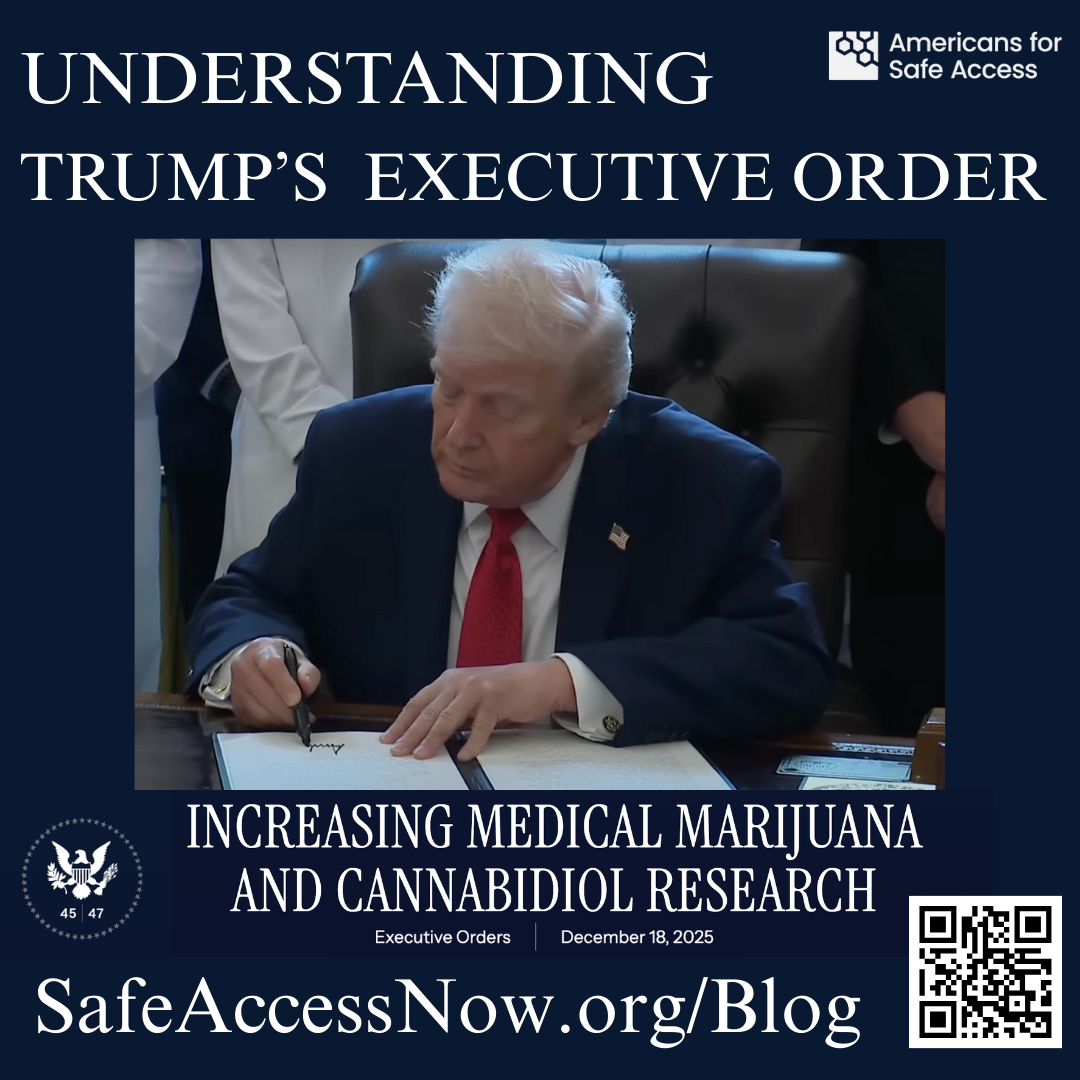 On December 18, 2025, President Trump signed an Executive Order titled “Increasing Medical Marijuana and Cannabidiol Research,” marking a milestone shaped by decades of patient advocacy and scientific progress. While some news coverage has overstated its immediate impact, the Order represents a meaningful step forward in the federal government’s engagement with medical cannabis policy.
The Executive Order does not itself change federal law or establish new patient protections. Instead, it directs federal agencies and Congress to begin advancing medical cannabis and cannabinoid policy. How far—and how fast—that work moves will depend on continued leadership from patient advocates, healthcare professionals, and lawmakers.
What makes this moment especially significant is what the Order affirms: recognition that cannabis has a “currently accepted medical use” has now moved beyond federal health agencies and been acknowledged by the White House. This development comes as multiple federal policy changes are already underway for 2026. Below, we break down what the Executive Order does—and what it means for medical cannabis advocates in the year ahead.
"Increasing Medical Marijuana and Cannabidiol Research" Breakdown
The Executive Order directs several federal agencies to advance research and policy coordination related to medical cannabis and cannabinoid products. However, it does NOT reschedule cannabis, legalize medical use, or create new patient protections.
Specifically, the Order directs:
- The Attorney General to expedite completion of the ongoing process to reschedule marijuana to Schedule III of the Controlled Substances Act (CSA).
- The White House Deputy Chief of Staff for Legislative, Political, and Public Affairs to work with Congress to allow Americans to benefit from access to appropriate full-spectrum CBD products, while restricting products that pose serious health risks.
- The Department of Health and Human Services (HHS) to develop research methods and models using real-world evidence to improve access to hemp-derived cannabinoid products, in accordance with federal law, and to inform standards of care.
The Order further specifies that these activities are to be carried out using existing HHS budget authority, underscoring that implementation will depend on agency prioritization and congressional appropriations decisions.
CLARIFICATION: The Executive Order Does NOT Reschedule Cannabis
Despite widespread media reporting, the Executive Order does not itself reschedule cannabis. Any change to cannabis’s classification under the Controlled Substances Act (CSA) will not take effect unless and until the Drug Enforcement Administration (DEA) completes the formal rescheduling process initiated under the Biden Administration.
That process had reached one of its final stages—an Administrative Law Judge (ALJ) hearing—before stalling just days before the hearing was scheduled to begin due to an interlocutory appeal filed by a witness. Under the Executive Order, the Attorney General may direct the DEA to move forward using one of several procedural options:
- Resume the existing ALJ process, which would require resolving the pending interlocutory appeal and appointing a new Administrative Law Judge to replace Judge Mulrooney.
- Terminate the current ALJ proceedings and issue a new Notice of Hearing on Proposed Rulemaking. Under established ALJ case law, any new hearing would still center on HHS’s Schedule III recommendation.
- Issue a final scheduling determination without an ALJ hearing, proceeding directly to a final rule that would then be subject to judicial review.
Alternatively, the Attorney General could attempt to bypass the existing process by invoking authority under 21 U.S.C. § 811, if sufficient justification can be established. This approach could still require an ALJ hearing, would almost certainly trigger extensive judicial review, and could invite congressional scrutiny under the Congressional Review Act.
Each option carries legal and political risk, particularly given congressional efforts to intervene through the appropriations process.
Appropriations Threat: Rescheduling Could Be Halted UPDATE: SEC 607 was removed in the final CJS bill
House Republicans are actively attempting to block DEA authority to complete rescheduling through FY2026 appropriations. The House-passed FY2026 Commerce, Justice, Science (CJS) bill includes the following provision:
SEC. 607: “None of the funds appropriated or otherwise made available by this Act may be used to reschedule marijuana… or remove marijuana from the schedules….”
If this language is enacted before the DEA completes the process, rescheduling will come to a complete halt—regardless of the Executive Order or prior HHS findings. See ASA’s FY2026 CJS Appropriations Requests for recommended fixes.
Schedule III: What It Does—And Does Not—Do
The Executive Order reinforces public narratives that rescheduling represents a major policy shift. In practice, Schedule III does not meaningfully change patients’ legal status or access to care.
While rescheduling acknowledges what patients and clinicians have long known—that cannabis has medical value—it does NOT:
- Legalize medical cannabis
- Improve state medical cannabis programs
- Restore federal rights for patients
- Protect patients from discrimination
- Ensure nationwide access
- Integrate cannabis into federal healthcare systems
Under Schedule III, cannabis remains illegal under federal law outside of tightly regulated federal channels. Patients remain vulnerable to loss of housing, employment, parental rights, and other serious consequences simply for following a physician’s recommendation.
State-authorized medical cannabis products would remain outside federally regulated medical frameworks unless Congress acts. There is no automatic registration pathway, no prescription model, no federal recognition of state products as lawful medicines, and no clear route for these products to be used in federally sanctioned clinical efficacy trials.
Even under Schedule III, cannabis manufacturing and distribution outside federal protocols remain classified as drug trafficking under federal law.
For Schedule III substances, penalties can include:
Up to 10 years in prison and a $500,000 fine for a first offense Up to 20 years and $1 million for subsequent offenses
State medical cannabis programs are currently protected only through the annually renewed CJS medical cannabis amendment, which applies to medical programs—but not adult-use markets—and must be reauthorized each year. Without this protection, patients and providers face renewed federal risk.
Schedule III & Cannabis Business Tax Deductions
One frequently misunderstood aspect of cannabis rescheduling involves federal tax treatment. While placing cannabis in Schedule III would remove the automatic application of Internal Revenue Code Section 280E, this change alone would not guarantee that cannabis businesses can deduct ordinary business expenses.
Other provisions of federal tax law still apply to activity that remains illegal under federal law. For example, 26 U.S.C. § 162(c) limits deductions related to illegal payments, and longstanding Supreme Court rulings—United States v. Sullivan (1927) and James v. United States (1961)—confirm that income from illegal activity is taxable even when related expenses may not be deductible.
Rescheduling may remove one tax barrier, but without congressional action to create a lawful federal medical cannabis framework, tax treatment for cannabis businesses will remain uncertain.
Access Full Spectrum Products
Expanding access to appropriate full-spectrum CBD products, however, will require congressional action—specifically, amendments to H.R. 5371. Executive or agency action alone cannot override statutory limits.
Securing that legislative pathway will be difficult. The chairs of the House and Senate Commerce, Justice, Science, Health and Human Services, and Agriculture Committees remain strongly opposed to cannabis reform. Compounding that challenge, letters condemning Schedule III were delivered to the White House the day before the Executive Order, signed by 22 U.S. Senators and 26 House Members.
Rescheduling does not create a lawful pathway for state medical cannabis programs or integrate cannabis into federal healthcare systems. The Executive Order’s directive for HHS to develop research methods and models utilizing real-world evidence to improve access to hemp-derived cannabinoid products, in accordance with federal law and to inform standards of care, could represent an initial step toward integrating cannabinoid-based treatments into U.S. healthcare systems.
A Meaningful Opening for Patient-Centered Research & Standards of Care
One of the most promising directives in the Executive Order instructs the Department of Health and Human Services (HHS) to develop research methods and models using real-world evidence to improve access to cannabinoid products and to inform standards of care. The Order specifically calls for coordination among HHS, the Food and Drug Administration (FDA), the Centers for Medicare & Medicaid Services (CMS), and the National Institutes of Health (NIH), bringing healthcare delivery, regulation, and research into the same conversation.
By recognizing the value of real-world use data and patient-reported outcomes, this directive opens the door to evidence-based standards of care that better reflect how cannabinoid therapies are actually used by patients today—and could help guide future healthcare integration if supported through appropriations.
This is an early but important step toward having patients’ real-world experiences shape how cannabinoid therapies are studied, understood, and eventually integrated into healthcare but the breadth of this directive could depend on HHS appropriations. See ASA’s FY2026 HHS Appropriations Requests.
Recognition Is Progress—But Patients Need Protection
The December 2025 Executive Order acknowledges medical reality—but acknowledgment is not access.
Rescheduling is a necessary step, but a limited one. Without congressional leadership to establish federal protections, create a lawful regulatory pathway for medical cannabis, and integrate cannabis and cannabinoids into healthcare and research systems designed around patient safety, patients remain in a holding pattern: recognized, but unprotected.
Get involved!
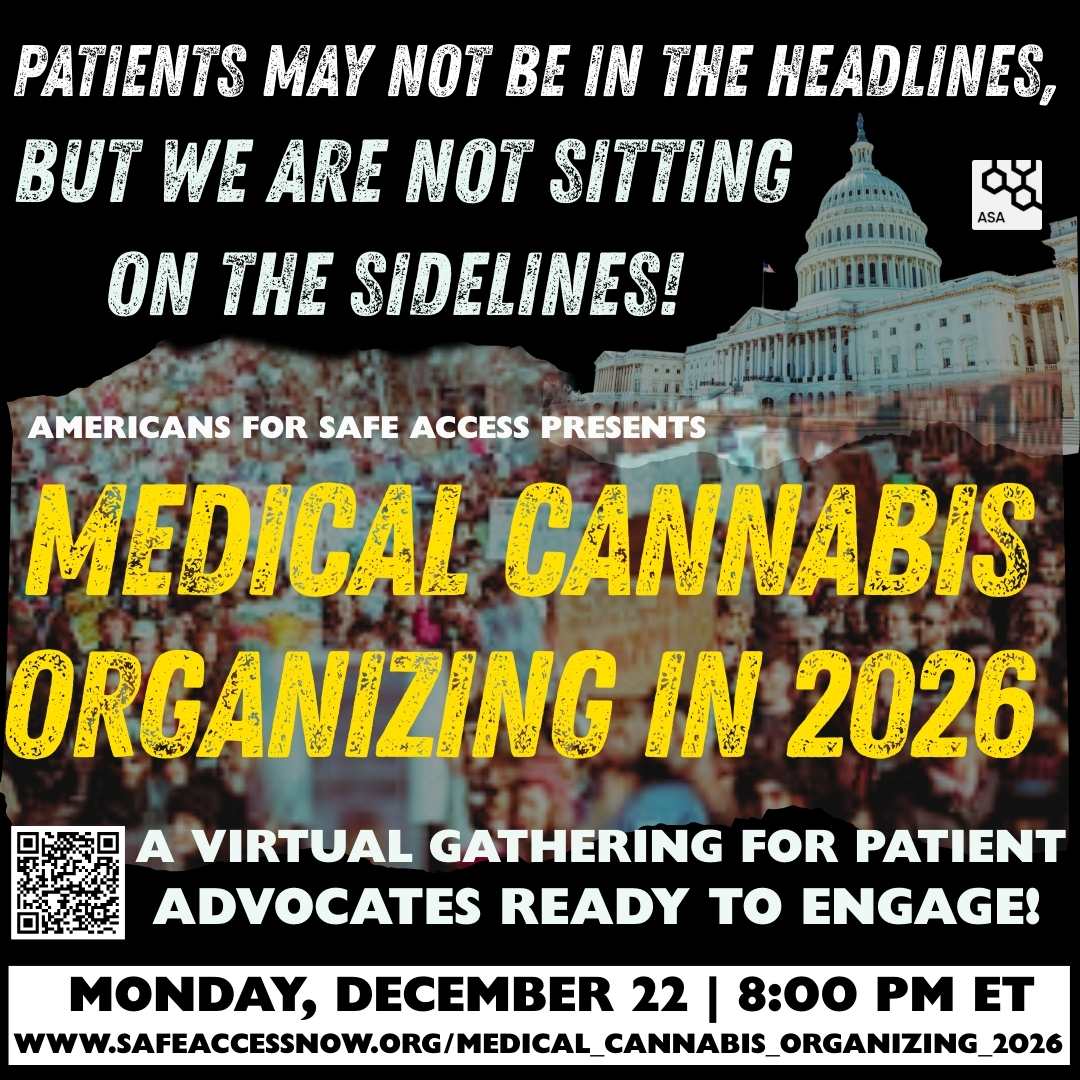
Click on the image below to join us on Monday, December 22, 8 pm ET
If you appreciate ASA's work, sign up to get alerts and updates and make a donation to support ASA's vital mission.

Share this page