 A key element of civil rights protections is the right not to disclose one's health status. A patient or caregiver should only disclose their status as a medical cannabis patient if they have to request special accommodations.
Medical Cannabis is no longer considered an illicit drug, so there is no need to hesitate when filling out forms that ask about a history of drug use. There is also no need to volunteer any information about your medical cannabis status, either.
Preparing to face outdated policies in many areas of life.
Assume Best Intentions. Remember, this is a fairly new law; chances are, your encounter may be the first time the perpetrator of the discrimination is hearing that medical cannabis patients have rights. Be prepared to explain that cannabis used through a state medical cannabis program is medicine within a lawful medical framework now recognized under federal law.
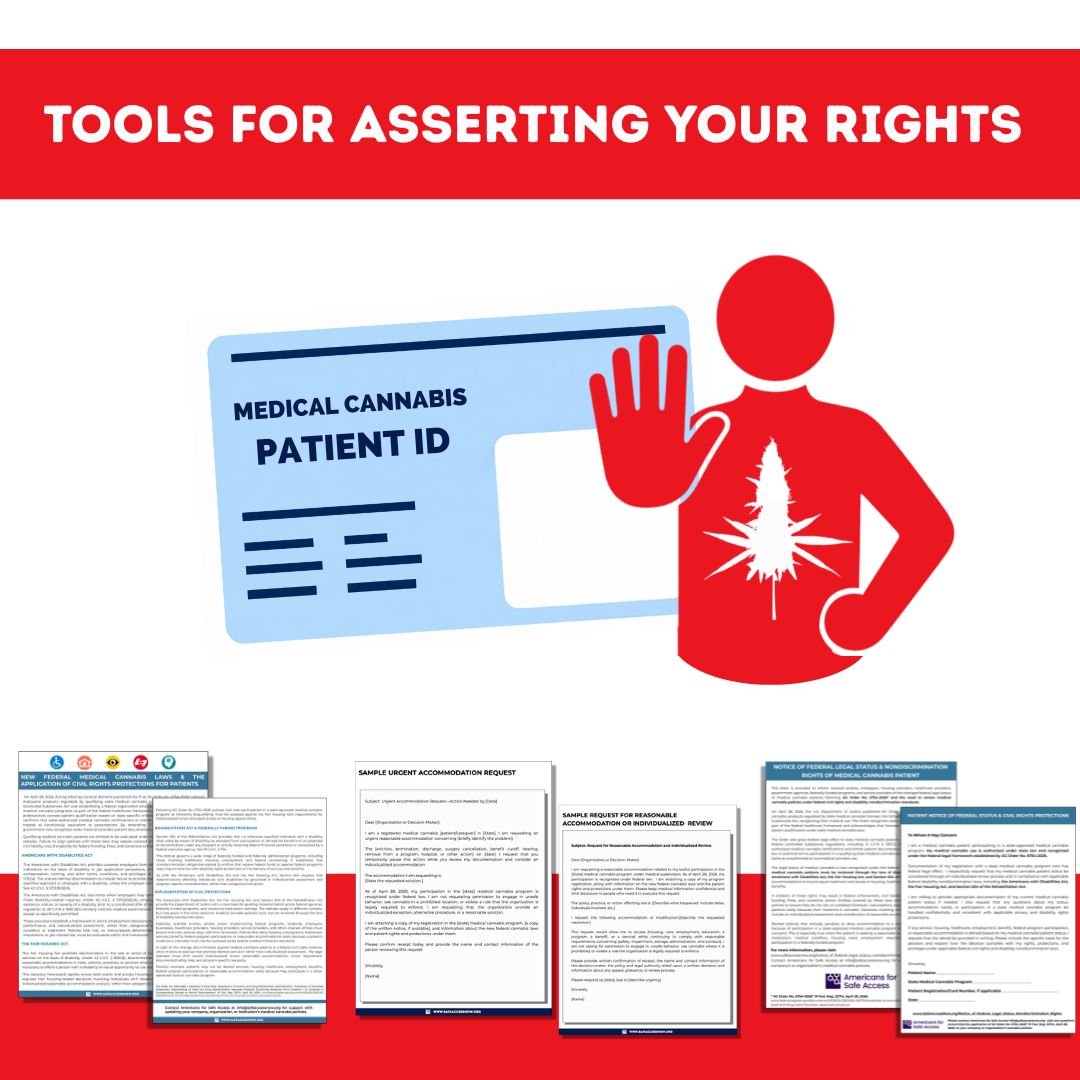
Americans for Safe Access created these documents for patients and caregivers to use to educate institutions and assert their rights. The "New Federal Medical Cannabis Laws & The Application of Civil Protections for Patients" is an overview of the federal rights and protections that now apply to medical cannabis patients. The "Notice of Federal Legal Status & Nondiscrimination Rights of Medical Cannabis Patient" one-pagers are designed to support patients and caregivers in discussions with employers, housing providers, healthcare providers, government agencies, federally funded programs, and service providers.
 |
 |
 |
These one-pagers can be shared with employers, housing providers, healthcare providers, government agencies, federally funded programs, public benefit programs, schools, service providers, and other institutions that may need to update outdated policies. Patients and caregivers can use these documents when they need to explain their federal legal status, request fair treatment, ask for individualized review, or challenge policies that still treat medical cannabis patients as categorically engaged in illegal drug use.
Articulating Patient Status.
When you do have to discuss medical cannabis use with employers, landlords, healthcare providers, agencies, schools, public programs, or service providers, patients should describe themselves clearly and accurately:
“I am a medical cannabis patient participating in a state-authorized medical cannabis program.”
Caregivers can use similar language:
“I am an authorized caregiver for a medical cannabis patient participating in a state-authorized medical cannabis program.”
Patients and caregivers should not allow others to frame medical cannabis as non-medical use, misconduct, substance misuse, or criminal activity.
Requesting Reasonable Accommodations.
A reasonable accommodation is a change to a rule, policy, schedule, or usual practice that allows a person with a disability to have equal access to a job, home, healthcare service, benefit, or program.
For medical cannabis patients, a reasonable accommodation might include, but not be limited to:
- Allowing a patient to explain a positive drug test;
- Adjusting a medication schedule when it does not interfere with job duties or safety;
- Allowing vaporizing of medical cannabis when vaping is otherwise prohibited;
- Making an exception to a housing policy that automatically treats all cannabis use as illegal;
- Allowing secure storage of a patient’s medicine in a healthcare facility, school, or workplace; or
- Reviewing a patient’s situation individually instead of applying an automatic ban.
A patient usually must ask for an accommodation. The patient should clearly explain that they have a medical condition, that a rule or policy is creating a problem, and what change would help.
The request should be made in writing whenever possible. Patients may be asked to provide limited medical information showing that they have a disability and need the accommodation. They generally do not have to provide their entire medical history.
An employer, landlord, healthcare provider, or other covered organization does not have to approve every request. It may deny an accommodation that would cause a serious difficulty or expense, create a documented safety risk, prevent someone from performing essential job duties, or fundamentally change the nature of a program or service.
However, a request should not be denied simply because it involves medical cannabis. The organization should review the patient’s individual circumstances, consider possible alternatives, and explain the decision. A blanket policy that rejects every medical cannabis patient without review may violate federal law.
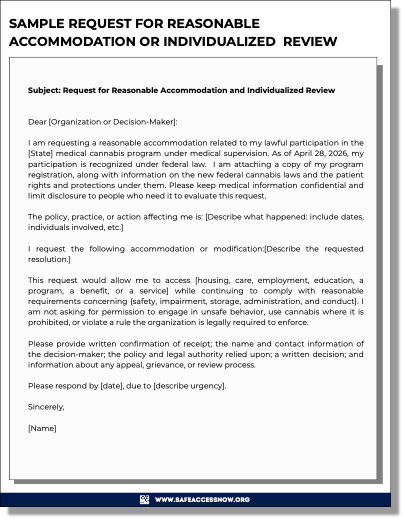
Download Sample Request for Reasonable Accommodations
Anticipating Need for Reasonable Accommodations.
If the patient is entering the care of a hospital, hospice, or assisted living facility, or if an employer or future employer requests a drug test, this is the time to request reasonable accommodations.
Be prepared. Bring the patient's medical cannabis program documentation and a copy of the "Notice of Federal Legal Status & Nondiscrimination Rights of Medical Cannabis Patient."
“I am a medical cannabis patient participating in a state-authorized medical cannabis program. I am requesting a reasonable accommodation to use medical cannabis based on my status. Please let me know the hospital's policy and confirm the process for submitting documentation."
“I am a medical cannabis patient participating in a state-authorized medical cannabis program. I am requesting an individualized review based on my status. Please confirm the process for submitting documentation.”
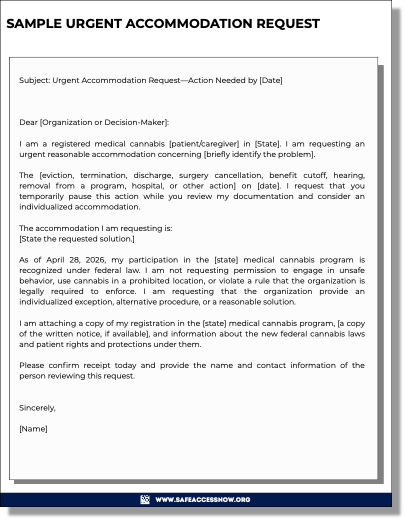
Download Sample Urgent Accommodation Request
For more resources, check out Patient & Caregiver Guide to New Cannabis Laws.
If you appreciate ASA's work, sign up for alerts and updates, and make a donation to support ASA's vital mission

Share this page