ASA’s Patient & Caregiver Guide to New Cannabis Laws
What You Need to Know to Exercise Your Rights Under the New Cannabis Laws
Americans for Safe Access designed this guide to give you the information and tools you need to navigate the new federal cannabis laws and put your rights into practice. Learn how to qualify for federal protections, assert your rights, and challenge outdated policies with confidence.
DOWNLOAD ONLINE VERSION (links to Forms) | DOWNLOAD PRINT VERSION (includes all forms & outreach materials)


On April 28, 2026, the Department of Justice issued AG Order No. 6754-2026, placing cannabis products regulated by qualifying state medical cannabis licenses into Schedule III of the Controlled Substances Act. For the first time, federal law recognizes state medical cannabis programs as part of the healthcare landscape and recognizes patients participating in those programs as using cannabis under a lawful medical framework.

This change validates the real-world experiences of patients and medical professionals. Registered medical cannabis patients can no longer be excluded or punished simply for using cannabis as medicine.

Federal laws affect far more than whether a patient can possess cannabis. For years, medical cannabis patients were excluded from basic protections. and extends federal rights and protections in housing, employment, healthcare, and federal services and programs.
The rights and protections under the Americans with Disabilities Act, the Fair Housing Act, and Section 504 of the Rehabilitation Act now apply to medical cannabis patients. But agencies, employers, landlords, healthcare facilities, and public programs will not automatically update their policies just because the law has changed.

Some systems will move slowly. Some will resist. Some may try to ignore the change altogether.
While the implications of these new laws are sweeping, the AG Order includes instructions only for the Treasury Department and the Drug Enforcement Administration. Aside from the ATF, no other federal agency has addressed the now-conflicting internal policies that discriminate against medical cannabis patients. The DOJ has not provided guidance to the private sector on recognizing patients’ rights.
Medical cannabis patients still need to be prepared to assert their rights and push public and private systems to catch up with the law. Patients and caregivers should expect the burden of educating landlords, employers, and service providers to fall on them. Don't be surprised if you are presented with outdated policies, forms, drug-testing rules, housing policies, hospital protocols, or agency practices.


The recognition of cannabis as legitimate medicine grants patients federal rights and protected access. But rights mean very little if people are too afraid, too isolated, or too exhausted to use them. Medical cannabis patients have spent decades hiding their medicine and avoiding disclosure because of the very real risk of losing housing, employment, healthcare, child custody, public benefits, services, or medical procedures.
Medical cannabis patients in state-approved programs must assert their rights, demand fair treatment, and challenge outdated policies. This will require advocacy from every angle: the White House, federal agencies, Congress, state agencies, healthcare providers, landlords, employers, and patients themselves.
ASA is here to help!
Americans for Safe Access created this guide to help patients and caregivers understand what has changed, how to assert their rights, how to document discrimination, and how to help end policies that still punish people for using cannabis as medicine.


Federal protections depend on being actively registered and up to date with your state medical cannabis program.
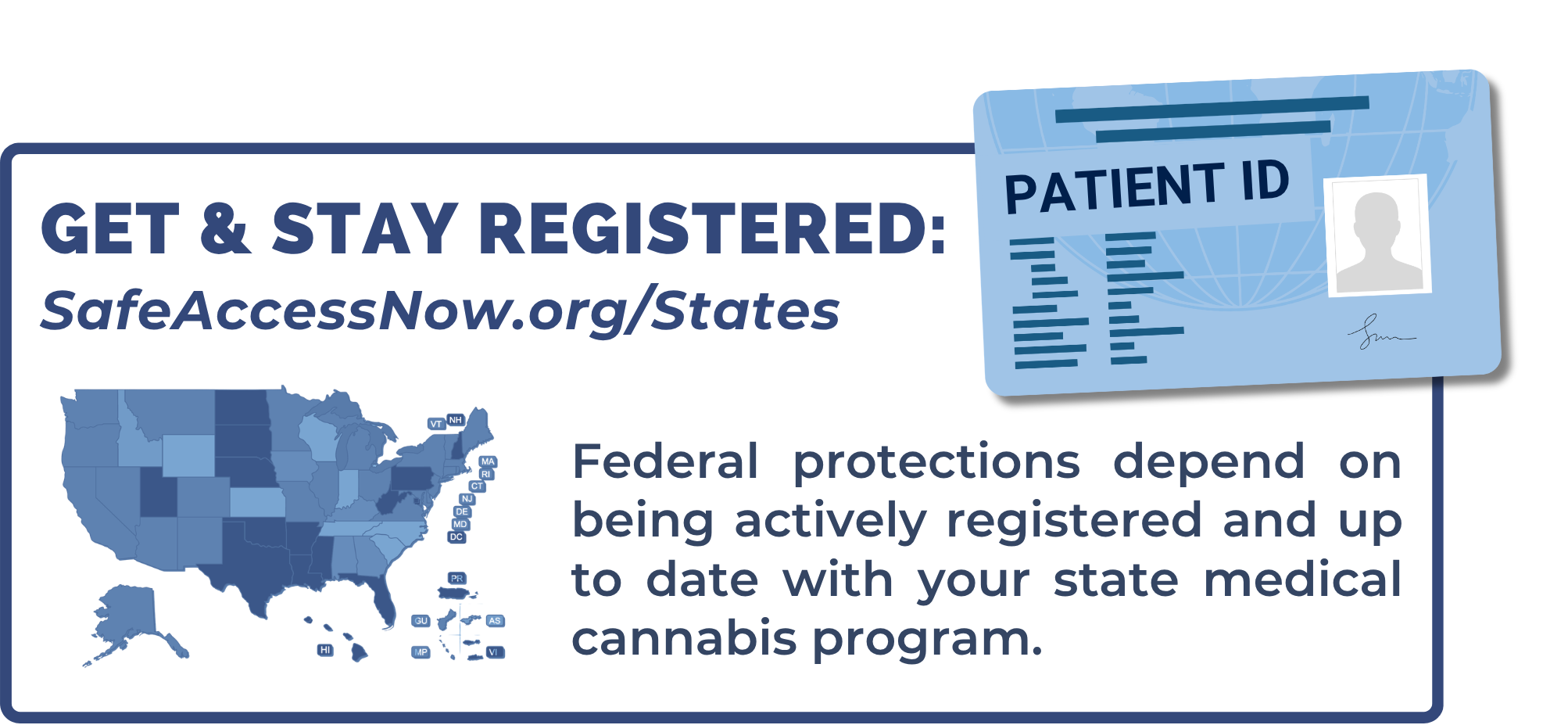
Federal protections are tied to participation in a lawful medical framework. Patients and caregivers should make sure their state medical cannabis registration, certification, or caregiver authorization is active, current, and in good standing. Use this resource for information on becoming a legal patient in your state.
Patients should keep copies of their state medical cannabis ID card, healthcare provider certification or recommendation, caregiver authorization, renewal documentation, and product information where appropriate. Do not wait until there is a problem to organize these records.
Stay Registered and Keep Your Documentation Current!

A significant element of civil rights protections is the right not to have to disclose one's health status. A patient or caregiver should only disclose their status as a medical cannabis patient if they have to request special accommodations.
Medical Cannabis is no longer considered an illicit drug, so there is no need to hesitate when filling out forms that ask about a history of drug use. There is also no need to volunteer any information about your medical cannabis status, either.
Medical cannabis patients & caregivers should be prepared to face outdated policies in many areas of life.
Assume Best Intentions. Remember, this is a fairly new law; chances are, your encounter may be the first time the perpetrator of the discrimination is hearing that medical cannabis patients have rights. Be prepared to explain that cannabis used through a state medical cannabis program is medicine within a lawful medical framework now recognized under federal law.
Americans for Safe Access created these documents for patients and caregivers to use to educate institutions and assert their rights. The "New Federal Medical Cannabis Laws & The Application of Civil Protections for Patients" is an overview of the federal rights and protections that now apply to medical cannabis patients. The "Notice of Federal Legal Status & Nondiscrimination Rights of Medical Cannabis Patient" one-pagers are designed to support patients and caregivers in discussions with employers, housing providers, healthcare providers, government agencies, federally funded programs, and service providers.
 |
 |
 |
These one-pagers can be shared with employers, housing providers, healthcare providers, government agencies, federally funded programs, public benefit programs, schools, service providers, and other institutions that may need to update outdated policies. Patients and caregivers can use these documents when they need to explain their federal legal status, request fair treatment, ask for individualized review, or challenge policies that still treat medical cannabis patients as categorically engaged in illegal drug use.
Tips on Asserting Rights
When you do have to discuss medical cannabis use with employers, landlords, healthcare providers, agencies, schools, public programs, or service providers, patients should describe themselves clearly and accurately:
“I am a medical cannabis patient participating in a state-authorized medical cannabis program.”
Caregivers can use similar language:
“I am an authorized caregiver for a medical cannabis patient participating in a state-authorized medical cannabis program.”
Patients and caregivers should not allow others to frame medical cannabis as non-medical use, misconduct, substance misuse, or criminal activity.
If the patient is entering the care of a hospital, hospice, or assisted living facility, or if an employer or future employer requests a drug test, this is the time to request reasonable accommodations.
Be prepared. Bring the patient's medical cannabis program documentation and a copy of the "Notice of Federal Legal Status & Nondiscrimination Rights of Medical Cannabis Patient."
“I am a medical cannabis patient participating in a state-authorized medical cannabis program. I am requesting a reasonable accommodation to use medical cannabis based on my status. Please let me know the hospital's policy and confirm the process for submitting documentation."
“I am a medical cannabis patient participating in a state-authorized medical cannabis program. I am requesting an individualized review based on my status. Please confirm the process for submitting documentation.”
Types of Discrimination.
- In housing, patients may face lease denials, eviction threats, refusal of reasonable accommodation, or housing policies that treat medical cannabis as illegal drug activity.
- In employment, workers and job applicants may face drug testing policies, hiring denials, discipline, termination, or refusal of accommodation.
- In healthcare, patients may be denied care, surgery, pain treatment, organ transplants, prescription medications, or access to medical facilities because of medical cannabis.
- Patients may be denied federal services, benefits, accommodations, or participation in federally funded programs.
- Parents, guardians, students, and caregivers may also face assumptions that medical cannabis use is neglect, misconduct, or unsafe behavior.
Under the new federal framework, these are all forms of unlawful discrimination as the rights and protections under the Americans with Disabilities Act, the Fair Housing Act, and Section 504 of the Rehabilitation Act now apply to medical cannabis patients.
If you encounter any of these forms of discrimination, ask if they are aware of the new cannabis laws and disclose your patient status.
“I am a medical cannabis patient participating in a state-authorized medical cannabis program. My medical cannabis use is part of a lawful medical framework recognized under current federal policy. I am requesting that this matter be reviewed through an individualized process and not treated as automatic misconduct or illegal drug use.”

If you are denied housing, care, employment, benefits, services, or accommodations, ask for a copy of the policy and the written decision. A written explanation can help identify whether the decision is based on outdated assumptions, stigma, or policies that need to be challenged.
Patients should not be automatically excluded from housing, healthcare, employment, public benefits, federal services, or private services solely because they are registered medical cannabis patients.
A cannabis-positive test alone does not prove impairment, misconduct, unsafe conduct, poor performance, or lack of fitness for duty. Ask
“Was this decision based solely on my medical cannabis patient status or a cannabis-positive test, or was an individualized review conducted based on actual evidence of risk, impairment, safety, or job-related concerns?”
Policies must move toward individualized review, actual risk, clinical judgment, reasonable accommodation, and evidence-based decision-making.
Documentation is not just paperwork. It is how individual experiences become evidence for policy change.
If a patient or caregiver is denied housing, care, employment, benefits, services, custody, accommodation, or participation in a program because of medical cannabis, they should ask for the decision and policy in writing.
“Please provide the policy you are relying on and the specific reason for this decision in writing.”
Patients should save emails, letters, denial notices, drug-testing communications, housing notices, eviction threats, employment policies, medical records, hospital policies, public benefit notices, custody or school communications, program rules, and the names of decision-makers.
If a conversation happens by phone or in person, patients should write down what happened as soon as possible afterward. Include the date, time, names of people involved, what was said, and what decision was made.
These records can help advocates, attorneys, agencies, and policymakers understand where patients are still being harmed and which policies need to change.

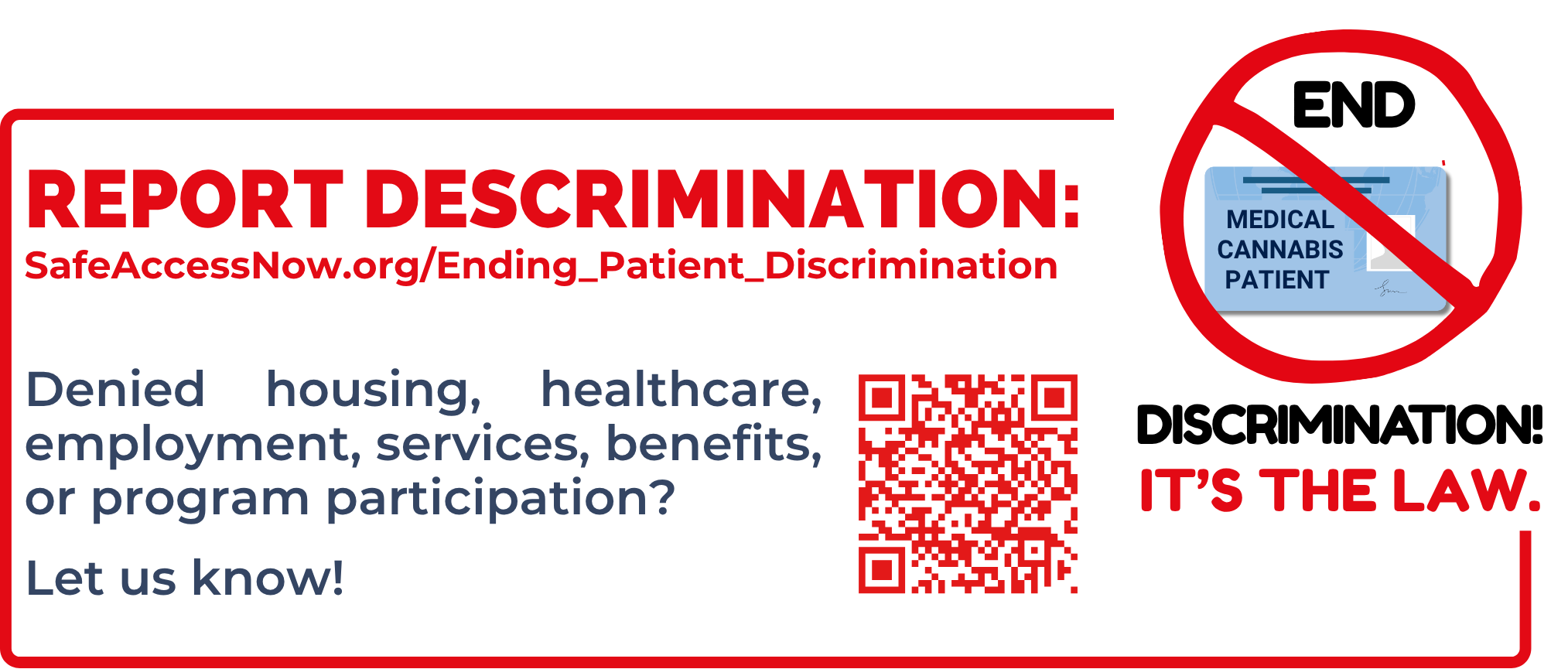
Americans for Safe Access is collecting reports from patients, caregivers, veterans, workers, tenants, parents, service members, and others who have experienced discrimination because of medical cannabis. Discrimination is often treated as an isolated problem when patients face it alone. But when patients report what happened, ASA can identify patterns and push for broader change.
ASA needs to hear from people who have been denied housing, employment, healthcare, surgery, pain care, organ transplants, public benefits, federal services, veterans’ services, education, custody rights, reasonable accommodations, or other services or protections because of their medical cannabis patient or caregiver status.
These reports help ASA identify patterns, educate policymakers, support legal and administrative advocacy, and push agencies, institutions, and private actors to update harmful policies.
 HOUSING
Report if you were denied housing, threatened with eviction, evicted, denied a reasonable accommodation, denied federally assisted housing, denied a lease renewal, or penalized by a landlord or housing provider because of medical cannabis. Download ASA's Documenting Housing Discrimination Checklist: www.SafeAccessNow.org/Discrimination_Housing
 HEALTHCARE
Report if you were denied medical care, denied pain management, dismissed from a pain clinic, required to stop medical cannabis to receive care, denied surgery, denied transplant evaluation, denied specialist care, or had cannabis treated as substance misuse instead of medicine. Download ASA's Documenting Healthcare Discrimination Checklist: www.SafeAccessNow.org/Discrimination_Healthcare
 HOSPITALS, HOSPICE, NURSING HOMES, ASSISTED LIVING, OR LONG-TERM CARE
Report if you were forced to stop medical cannabis, denied access to medical cannabis, denied caregiver administration, told a facility would not document cannabis as medicine, or told that federal funding rules prohibit medical cannabis. Download ASA's Documenting Care Facility Discrimination Checklist: www.SafeAccessNow.org/Discrimination_Care_Facilities
 FAMILY OR CHILD WELFARE
Report if medical cannabis affected a custody case, visitation dispute, adoption or foster care matter, or child welfare investigation. Download ASA's Documenting Family and Child Welfare Discrimination Checklists: www.SafeAccessNow.org/Discrimination_Family_Welfare
 EDUCATION
Report if a school, college, university, training program, testing organization, or campus housing provider denied you enrollment, participation, medication access, housing, or a reasonable accommodation because of medical cannabis. Download ASA's Documenting Education Discrimination Checklists: www.SafeAccessNow.org/Discrimination_Discrimination_Education
 GOVERNMENT BENEFITS OR PUBLIC SERVICES
Report if medical cannabis affected child custody, triggered a child welfare investigation, resulted in denial of a school accommodation, or caused denial of disability benefits, public benefits, transportation, or public services. Download ASA's Documenting Government Benefits & Services Discrimination Checklists: www.SafeAccessNow.org/Discrimination_Government_Benefits
 EMPLOYMENT
Report if you were denied a job, fired, suspended, disciplined, denied a promotion, denied return to work, failed a drug test despite medical cannabis patient status, or denied workplace accommodation. Download ASA's Documenting Employment Discrimination Checklists: www.SafeAccessNow.org/Discrimination_Employment
 FEDERAL EMPLOYMENT/CONTRACTOR ISSUES
Report if you were denied federal employment, denied a federal contractor position, disciplined under federal drug-free workplace rules, denied a clearance, denied a credential, or denied a federal workplace accommodation because of medical cannabis. Download ASA's Documenting Federal Employment/Contractor Discrimination Checklists: www.SafeAccessnow.org/Discrimination_Federal_Employment
 VETERANS’ SERVICES
Report if a VA clinician refused to provide a recommendation, forms, referral, or registration help; if medical cannabis affected your VA care; or if you were denied pain care, mental health care, housing, benefits, or services. Download ASA Documenting Veteran Discrimination Checklists: www.SafeAccessNow.org/Discrimination_Veterans_Services.

MILITARY OR SERVICE MEMBER ISSUES
Report if you were disciplined or threatened with discipline, ordered to stop medical cannabis or cannabinoid use, penalized for CBD or hemp-derived cannabinoid use, or if medical cannabis affected duty status, promotion, separation, transition planning, disability evaluation, or benefits. Download ASA Documenting Military Discrimination Checklists: www.SafeAccessNow.org/Discrimination_Military
 PRIVATE BUSINESSES, PUBLIC ACCOMMODATIONS, OR SERVICES
Report if you were denied service, denied entry, denied participation, denied reasonable accommodation, or penalized by a private business, event, program, facility, or service because of medical cannabis patient status. Download ASA Documenting Private-Public Services Discrimination Checklists: SafeAccessNow.org/Discrimination_Private-Public_Services
 MISCELLANEOUS
Report any discrimination because of medical cannabis that does not fit clearly into one of these categories. Download ASA's Documenting Miscellaneous Discrimination Checklist: SafeAccessNow.org/Discrimination_Miscellaneous

 ASA is calling on the White House, the Department of Justice, and federal agencies to make sure this change has practical meaning for patients.
Federal agencies must review and update policies that still treat medical cannabis patients as categorically engaged in illegal drug use. Policies, forms, enforcement practices, grant conditions, program rules, and guidance documents must be aligned with the new federal framework.
Federal policy must now move from automatic exclusion to individualized review, reasonable accommodation, patient safety, clinical judgment, actual evidence of risk, evidence-based decision-making, and protection from discrimination.
 Federal agencies must act now, but Congress also has a responsibility to make sure this transition protects patients.
ASA is calling on Congress to require agency cooperation through the appropriations process and to pass comprehensive medical cannabis legislation.
Through appropriations, Congress should require federal agencies to review and update policies, guidance documents, forms, enforcement practices, grant conditions, and program rules that still rely on outdated Schedule I assumptions.
Congress should also pass comprehensive medical cannabis legislation that creates a national medical cannabis program, protects patients, supports research, improves product safety, integrates cannabis into healthcare, and ends the patchwork of conflicting rules that leaves patients vulnerable.
Tell Congress to protect medical cannabis patients!
Patients should not have to fight these battles alone.
Patients and caregivers can share information with family members, healthcare providers, housing advocates, disability rights organizations, veterans’ groups, legal aid networks, patient communities, labor advocates, social workers, elected officials, local agencies, and community organizations.
The more people understand that registered medical cannabis patients are participating in a federally recognized medical framework, the harder it becomes for outdated policies to survive.
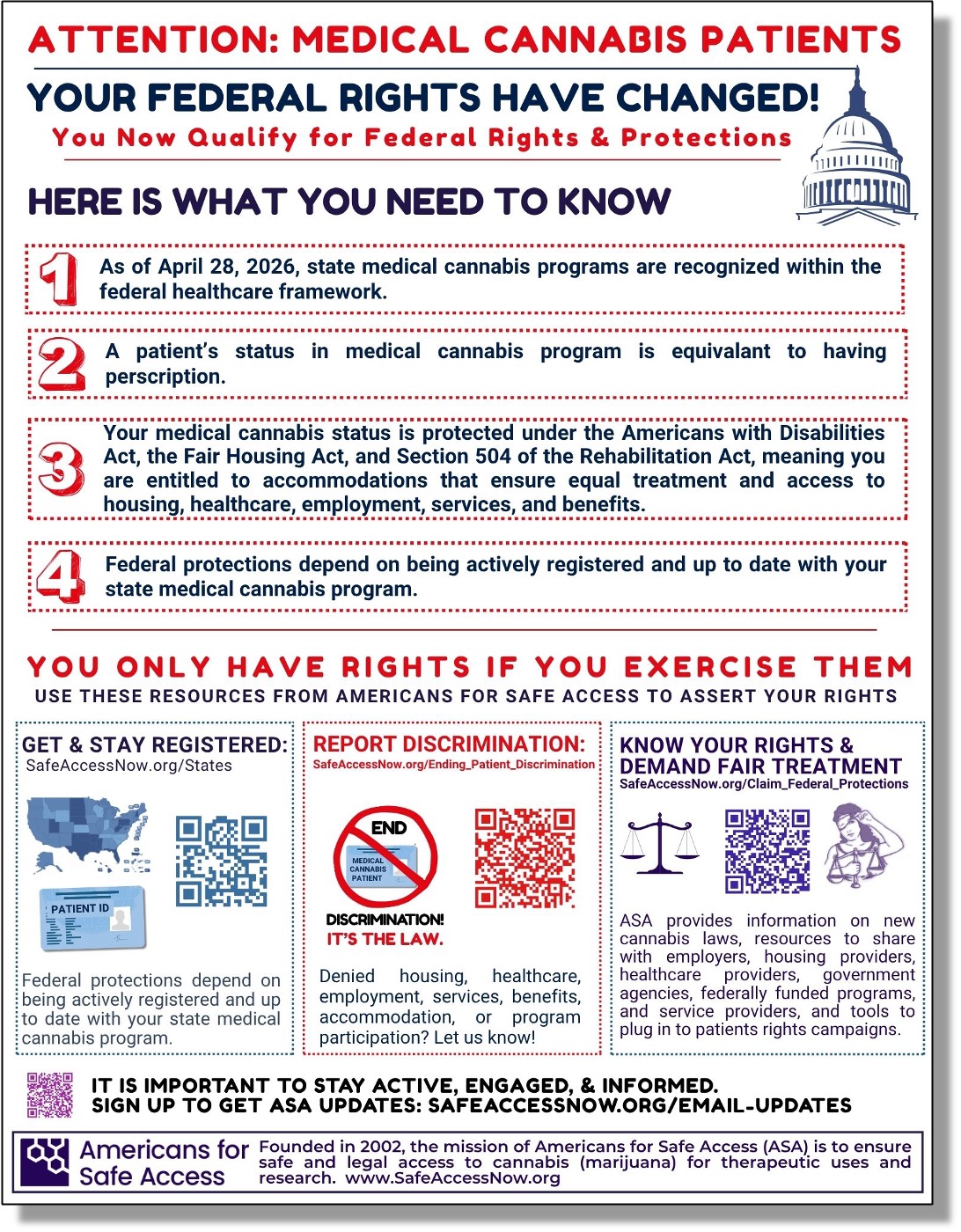
ASA has posters, flyers, notices, and educational materials available for patients, caregivers, advocates, and organizations.
Download and share ASA materials:


For years, federal policy treated cannabis as if it had no accepted medical use. That created a dangerous gap between state medical cannabis programs and federal systems. Patients who followed state medical cannabis laws were still often treated as if they were engaged in illegal drug use.
AG Order No. 6754-2026 changed that framework for FDA-approved cannabis products and cannabis products regulated by qualifying state medical cannabis licenses. Under the new federal framework, medical cannabis patients participating in state-approved programs are recognized as using cannabis under a lawful medical system.
That recognition creates a foundation for patients to demand fair treatment in housing, healthcare, employment, disability accommodations, federal services, public programs, and other areas of daily life.
Medical cannabis patients should no longer be automatically excluded or punished simply for using cannabis as medicine.
The short answer is: medical cannabis patients in states with medical cannabis laws are now on very different federal footing, but cannabis is not fully legal.
The new federal scheduling action recognizes qualifying medical cannabis as medicine and creates new opportunities for patient rights, research, and healthcare integration. For patients participating in state-approved medical cannabis programs, this is a major shift. It means patients now have a stronger legal basis to assert federal rights and protections in housing, employment, healthcare, disability accommodations, federally assisted housing, federal workplaces, veterans’ care, and other federal systems.
But this change does not mean cannabis is fully legal for everyone, everywhere. It does not legalize adult-use cannabis, deschedule cannabis, erase every federal criminal penalty, or automatically update every agency policy. It also does not mean patients can travel freely from state to state with their medicine or that protections apply to people who are not registered in a state medical cannabis program.
For patients, the most important takeaway is this: the legal premise has changed. Medical cannabis patients participating in state-authorized programs should no longer be treated as criminals simply because they use cannabis as medicine. But federal agencies, employers, landlords, healthcare providers, and public programs still need to update policies and practices to reflect that change.
That is why patients must stay registered, keep documentation current, assert their rights, report discrimination, and help ASA push agencies and Congress to make federal recognition meaningful in real life.
Medical cannabis patients should not be automatically excluded from housing, healthcare, employment, public benefits, federal services, or private services solely because they are registered medical cannabis patients.
A cannabis-positive test alone does not prove impairment, misconduct, unsafe conduct, poor performance, lack of fitness for duty, abuse, neglect, medical noncompliance, or inability to follow program rules.
Policies must move toward individualized review, actual evidence of risk, reasonable accommodation, clinical judgment, patient safety, and evidence-based decision-making.
Medical cannabis patients deserve the same seriousness, dignity, and individualized consideration given to other patients using legally recognized medicines.
The new federal framework is historic, but patients should understand its limits.
The order does not fully legalize cannabis, deschedule cannabis, or legalize adult-use cannabis. It applies to FDA-approved cannabis products and cannabis products regulated by qualifying state medical cannabis licenses. Cannabis obtained outside a DEA-registered, state-regulated medical cannabis system may still be treated differently under federal law.
For patients, the order does not automatically provide access or protections in states without medical cannabis laws. It does not change the status of hemp products. It does not allow patients to travel freely across state lines with their medicine. It does not expunge past federal cannabis-related criminal records. It does not automatically update every federal, state, local, or private policy used to deny patients housing, employment, healthcare, veterans’ services, disability accommodations, federal benefits, or access to public programs.
The order gives patients a stronger federal rights argument, but they should still be prepared to document problems and ask for written policies and decisions.
Federal agencies must issue guidance and update policies so patients are not forced to fight discrimination one case at a time.
ASA is working to make sure medical cannabis patients are protected in housing, healthcare, employment, veterans’ services, disability rights, public benefits, federal services, family settings, education, federal systems, and private services.
No patient should be punished for using cannabis as medicine.
ASA is fighting for federal policy that recognizes medical cannabis patients as patients, not criminals. That means updated agency guidance, enforceable protections, product safety standards, healthcare integration, research, and comprehensive federal legislation.
AG Order No. 6754-2026 is historic, but it is not the finish line. Patients need every federal agency to update its policies, and Congress must create a national medical cannabis program that protects patients, supports research, improves product safety, integrates cannabis into healthcare, and ends the patchwork of conflicting rules that leaves patients vulnerable.
Information on becoming a legal patient in your state.
Download Notice of Federal Legal Status: Patient
Download Notice of Federal Legal Status: Caregiver
Sign on to the letter to Trump & DOJ.
Tell Congress to protect medical cannabis patients!
Share this free ASA widget with organizations serving patients.
You do not need to wait for every agency, employer, landlord, hospital, school, or public program to figure this out. Medical cannabis patients and caregivers can claim these rights, protections, and privileges now.
Assert your rights. Be prepared. Demand fair treatment. Document and report discrimination. Educate your community. Take action.
The law has changed. Now, policy, practice, and enforcement must change too.
Americans for Safe Access is here to help.
If you appreciate ASA's work, sign up for alerts and updates, and make a donation to support ASA's vital mission.

Share this page