The Law Has Changed. Now the Policies Must Change.

For decades, medical cannabis patients have been denied jobs, housing, healthcare, benefits, educational opportunities, parental rights, and essential services simply because their medicine was cannabis. Employers, hospitals, landlords, government agencies, schools, benefits programs, and other institutions built policies around the assumption that medical cannabis patients were engaged in federally prohibited conduct.
The legal foundation has changed. On April 28, 2026, federal cannabis policy changed when the Department of Justice issued AG Order No. 6754 2026, placing FDA-approved cannabis products and cannabis products regulated by qualifying state medical cannabis licenses into Schedule III of the Controlled Substances Act.
It is time to end medical cannabis patient discrimination. Policies and practices built on the old law must now be examined and updated.
Medical cannabis patients can now assert rights and protections under the Americans with Disabilities Act, the Fair Housing Act, Section 504 of the Rehabilitation Act, and other laws and programs that affect housing, healthcare, employment, veterans’ services, public benefits, and federal systems.
FROM FEDERAL RECOGNITION TO REAL-WORLD PROTECTION
Ending patient discrimination requires more than changing federal scheduling. It requires changing government policies, institutional practices, professional standards, forms, training programs, and assumptions built during decades of federal prohibition. That is the goal of the End Medical Cannabis Patient Discrimination campaign!
ASA’s End Medical Cannabis Patient Discrimination campaign is a coordinated effort to turn changes in federal law into meaningful protections where patients live, work, receive healthcare, raise families, attend school, access benefits, and participate in their communities. ASA’s campaign works at every level of the problem, including Federal policy changes, Congressional advocacy, and federal agency engagement; patient and caregiver education; tools for asserting rights; discrimination reporting; education for institutions and professionals; standard operating procedures and training; research and reports on discrimination; administrative and legal advocacy; and Litigation when necessary.
 ASA is engaging the Administration and federal agencies to clarify how changes in federal cannabis law affect medical cannabis patients and to identify policies that continue to rely on outdated assumptions about cannabis.
This includes urging federal agencies to review policies, guidance, forms, program requirements, enforcement practices, workplace rules, healthcare policies, housing policies, veterans’ policies, disability protections, and other federal systems that may continue to treat medical cannabis patients as categorically engaged in illegal drug use.
ASA has provided the Administration with a detailed rationale for why federal guidance and policy review are necessary.
Read ASA's Rationale for Immediate Federal Guidance.
ASA has also organized a Patient Rights Sign On Letter addressing the need for federal clarification of civil protections and equal treatment for medical cannabis patients.
TAKE ACTION: Sign on to ASA's Patient Rights Letter to President Trump and DOJ.
 Administrative action can address many immediate conflicts, but a lasting national framework requires congressional action.
ASA’s federal policy work includes advocating for a nationwide medical cannabis program, stronger patient protections, federal agency coordination, healthcare integration, product safety, research, and policies that replace the current patchwork of conflicting federal and state rules.
ASA is also working with Congress on the role federal agencies should play in reviewing and updating policies that affect medical cannabis patients.
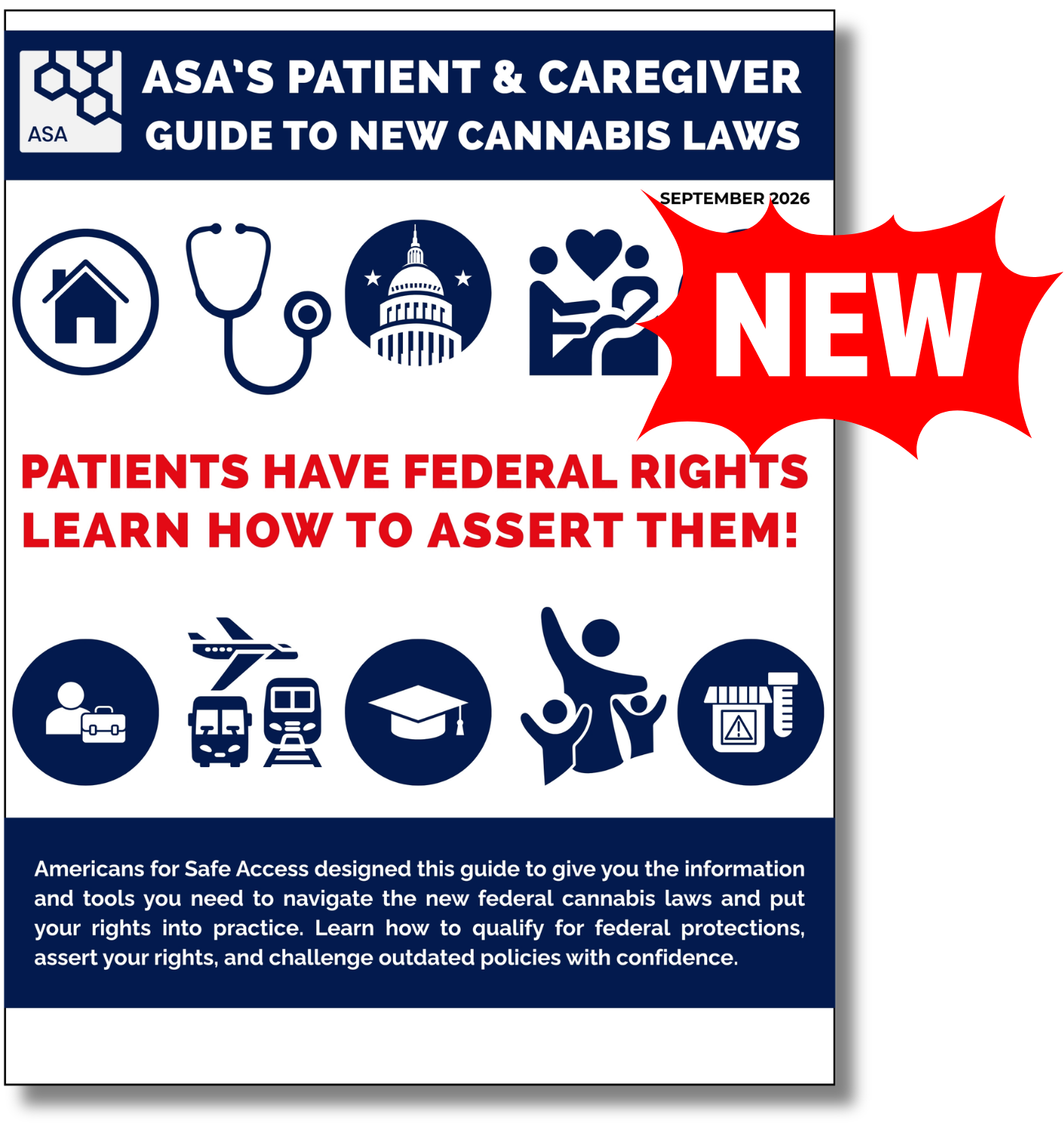 Rights are difficult to exercise if patients do not know they have them.
A major part of this campaign is making sure patients and caregivers understand what has changed, what has not changed, how federal protections may apply, what documentation they should keep, when they may need to disclose their medical cannabis status, and how to respond when they encounter an outdated policy.
ASA created the Patient and Caregiver Guide to New Cannabis Laws to put that information in patients’ hands.
The guide explains the new federal framework and gives patients practical information for maintaining their legal status, requesting individualized review or reasonable accommodation, documenting decisions, and responding to discrimination.
Read & Share ASA's Patient and Caregiver Guide to New Cannabis Laws.
Patients should not have to become legal experts every time they encounter an outdated policy.
ASA is creating practical tools patients and caregivers can bring into conversations with employers, landlords, healthcare providers, hospitals, government agencies, schools, service providers, and other institutions.
These resources include notices explaining federal legal status, sample accommodation requests, documentation tools, guidance for asking questions, and materials designed to help patients obtain written explanations when an institution takes action against them.
We cannot change policies we cannot see. Discrimination can take many forms. Sometimes it is obvious. Sometimes it is hidden inside an old policy, application, drug testing program, hospital rule, benefit requirement, or agency practice. If something happened to you because you are a medical cannabis patient, document it and report it.
ASA is collecting reports from patients, caregivers, veterans, workers, tenants, parents, students, service members, and others who experience discrimination related to medical cannabis. Patient reports allow ASA to identify recurring problems by institution, industry, state, federal agency, and type of harm.
One report may identify one bad decision. Multiple reports may reveal a company policy, hospital system practice, federal rule, housing policy, professional standard, or government program affecting thousands of people.
Documentation turns individual experiences into evidence for change.
ASA Tools for Reporting Discrimination
 HOUSING
Report if you were denied housing, threatened with eviction, evicted, denied a reasonable accommodation, denied federally assisted housing, denied a lease renewal, or penalized by a landlord or housing provider because of medical cannabis.
Download ASA's Documenting Housing Discrimination Checklist: www.SafeAccessNow.org/Discrimination_Housing
 HEALTHCARE
Report if you were denied medical care, denied pain management, dismissed from a pain clinic, required to stop medical cannabis to receive care, denied surgery, denied transplant evaluation, denied specialist care, or had cannabis treated as substance misuse instead of medicine.
Download ASA's Documenting Healthcare Discrimination Checklist: www.SafeAccessNow.org/Discrimination_Healthcare
 HOSPITALS, HOSPICE, NURSING HOMES, ASSISTED LIVING, OR LONG-TERM CARE
Report if you were forced to stop medical cannabis, denied access to medical cannabis, denied caregiver administration, told a facility would not document cannabis as medicine, or told that federal funding rules prohibit medical cannabis.
Download ASA's Documenting Care Facility Discrimination Checklist: www.SafeAccessNow.org/Discrimination_Care_Facilities
 FAMILY OR CHILD WELFARE
Report if medical cannabis affected a custody case, visitation dispute, adoption or foster care matter, or child welfare investigation.
Download ASA's Documenting Family and Child Welfare Discrimination Checklists: www.SafeAccessNow.org/Discrimination_Family_Welfare
 EDUCATION
Report if a school, college, university, training program, testing organization, or campus housing provider denied you enrollment, participation, medication access, housing, or a reasonable accommodation because of medical cannabis.
Download ASA's Documenting Education Discrimination Checklists: www.SafeAccessNow.org/Discrimination_Education
 GOVERNMENT BENEFITS OR PUBLIC SERVICES
Report if medical cannabis affected child custody, triggered a child welfare investigation, resulted in denial of a school accommodation, or caused denial of disability benefits, public benefits, transportation, or public services. Download ASA's Documenting Government Benefits & Services Discrimination Checklists: www.SafeAccessNow.org/Discrimination_Government_Benefits
 EMPLOYMENT
Report if you were denied a job, fired, suspended, disciplined, denied a promotion, denied return to work, failed a drug test despite medical cannabis patient status, or denied workplace accommodation. Download ASA's Documenting Employment Discrimination Checklists: www.SafeAccessNow.org/Discrimination_Employment
 FEDERAL EMPLOYMENT/CONTRACTOR ISSUES
Report if you were denied federal employment, denied a federal contractor position, disciplined under federal drug-free workplace rules, denied a clearance, denied a credential, or denied a federal workplace accommodation because of medical cannabis. Download ASA's Documenting Federal Employment/Contractor Discrimination Checklists: www.SafeAccessnow.org/Discrimination_Federal_Employment
 VETERANS’ SERVICES
Report if a VA clinician refused to provide a recommendation, forms, referral, or registration help; if medical cannabis affected your VA care; or if you were denied pain care, mental health care, housing, benefits, or services. Download ASA Documenting Veteran Discrimination Checklists: www.SafeAccessNow.org/Discrimination_Veterans_Services.

MILITARY OR SERVICE MEMBER ISSUES
Report if you were disciplined or threatened with discipline, ordered to stop medical cannabis or cannabinoid use, penalized for CBD or hemp-derived cannabinoid use, or if medical cannabis affected duty status, promotion, separation, transition planning, disability evaluation, or benefits. Download ASA Documenting Military Discrimination Checklists: www.SafeAccessNow.org/Discrimination_Military
 PRIVATE BUSINESSES, PUBLIC ACCOMMODATIONS, OR SERVICES
Report if you were denied service, denied entry, denied participation, denied reasonable accommodation, or penalized by a private business, event, program, facility, or service because of medical cannabis patient status. Download ASA Documenting Private-Public Services Discrimination Checklists: www.SafeAccessNow.org/Discrimination_Private-Public_Services
 MISCELLANEOUS
Report any discrimination because of medical cannabis that does not fit clearly into one of these categories. Download ASA's Documenting Miscellaneous Discrimination Checklist: www.SafeAccessNow.org/Discrimination_Miscellaneous
Your experiences can help protect other patients! Report discrimination here.
REPORTING MATTERS!
Discrimination often seems like an isolated problem when patients face it alone. But when patients report what happened, ASA can identify patterns and push for broader change.
Patient reports contribute to ASA's campaign to end discrimination by helping:
- Document the real-world impact of outdated policies;
- Identify agencies, institutions, and sectors where discrimination is continuing;
- Educate policymakers and regulators;
- Support legal, administrative, and legislative advocacy;
- Push federal and state agencies to issue updated guidance; and
- Build public understanding that medical cannabis patients deserve fair treatment.
TRACK WHAT IS HAPPENING
Patient reports also provide information ASA can use to measure how federal recognition is being implemented across the country. ASA will analyze patterns of discrimination and publish reports identifying recurring barriers, outdated policies, implementation gaps, emerging problems, and areas where federal or state guidance may be necessary. These reports can provide policymakers, agencies, institutions, medical professionals, attorneys, advocates, journalists, and patients with a clearer picture of what is happening outside Washington.
CHANGE THE PUBLIC CONVERSATION
Medical cannabis discrimination has often remained invisible because individual patients experience it privately. ASA’s communications strategy will bring those experiences into the public conversation while also highlighting institutions, policies, and solutions that demonstrate how patient protections can work.
The campaign will use patient experiences, research, policy analysis, reports, media outreach, educational materials, public communications, and examples of successful policy reform to show both where discrimination continues and how it can be fixed.
The objective is not simply to document problems. It is to make solutions visible!
CHALLENGE DISCRIMINATION WHEN NECESSARY
Education and voluntary policy changes should resolve many conflicts. They will not resolve all of them.
When institutions continue policies or practices that harm medical cannabis patients despite changes in federal law, litigation may be necessary to clarify rights, challenge discriminatory practices, and establish precedents that protect other patients. ASA will use patient reports, documentation, policy analysis, administrative advocacy, legal advocacy, and litigation when appropriate as part of the broader effort to end medical cannabis patient discrimination.
|
1. Know your status. Keep documentation of your state medical cannabis registration, healthcare provider certification, caregiver authorization, and product information where appropriate. 2. Ask for written explanations. If you are denied housing, care, employment, benefits, services, or accommodation, ask for the policy and decision in writing. 3. Use medical language. Describe yourself as a medical cannabis patient participating in a state-authorized program. Do not let others frame your medicine as non-medical use. 4. Request reasonable accommodation. Ask for reasonable accommodation. 5. Document everything. Save emails, letters, denial notices, drug-testing communications, housing notices, medical records, policy documents, and decision-maker names. 6. Report discrimination to ASA. Your experience can help change policy for thousands of other patients. |
Patients cannot be expected to carry the entire burden of explaining changes in federal law or correcting outdated policies on their own. Ending medical cannabis patient discrimination also requires educating the professionals and institutions whose decisions directly affect patients and giving them the tools to implement the law correctly.
ASA is developing educational resources, model policies, standard operating procedures, training materials, and implementation guidance for landlords and housing providers, educators and educational institutions, medical professionals, hospital administrators, hospitals and healthcare systems, hospices, assisted living and long-term care facilities, public defenders and legal service providers, private businesses and public accommodations, employers and human resources professionals, government agencies and public benefit programs, and veterans’ service providers.
Changing a written policy is only part of the solution. The people applying those policies also need accurate information. ASA’s training and implementation resources will help institutions understand the differences between medical cannabis patient status, nonmedical cannabis use, impairment, and substance misuse, issues that have historically been treated as interchangeable.
These tools can help organizations replace automatic exclusions and outdated assumptions with individualized review, medical judgment, reasonable accommodation, actual evidence of risk, and policies that reflect current federal law.
The goal is not simply to help patients challenge discrimination after it happens. The goal is to prevent discriminatory decisions from happening in the first place.
The Law Has Changed. Now, Enforcement Must Change Too.
Your support helps ASA turn new rights into real protections by providing patient assistance, challenging discriminatory policies, educating institutions, developing implementation tools, and advocating for the federal and state actions needed to fully integrate cannabis medicines into healthcare and everyday life. DONATE NOW!
Changes in cannabis laws at the state and federal levels require vigilance from advocates to ensure implementation in the public and private sectors respects patients' rights and accommodates them accordingly. Stay active, engaged, and informed. Sign up to get ASA updates!

Share this page