NAVIGATING ORGAN TRANSPLANTS FOR MEDICAL CANNABIS PATIENTS
What Patients and Caregivers Need to Know about Transplant Center Cannabis Policies, Medical Disclosure, Product Safety, and Protecting Access To Life-Saving Care.
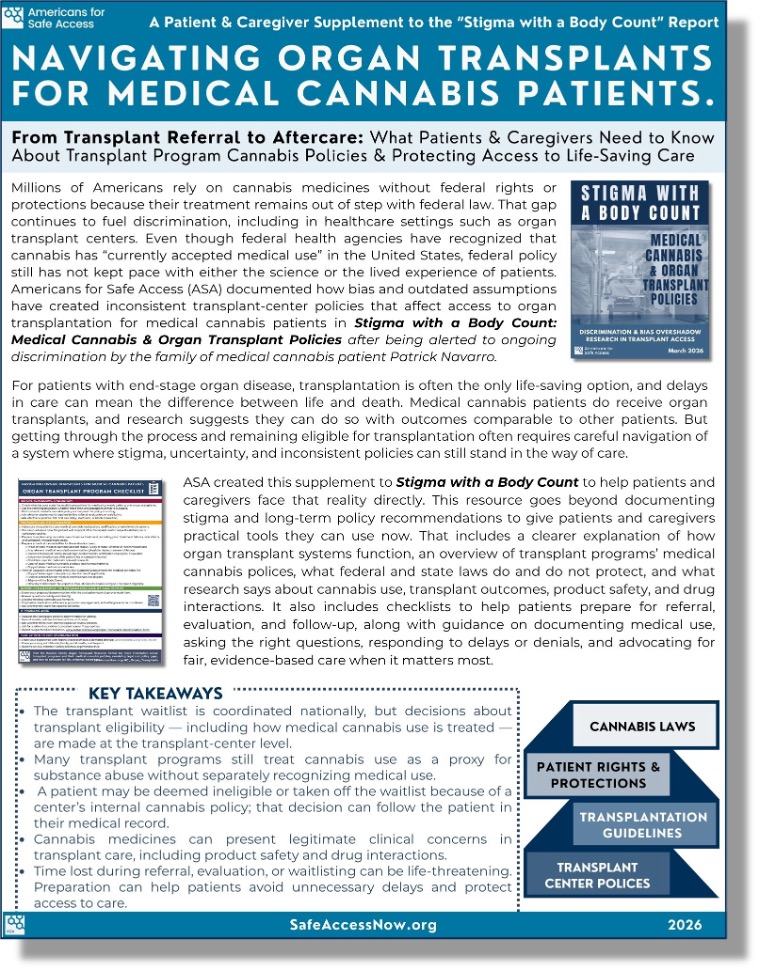
Millions of Americans rely on cannabis medicines through state medical cannabis programs, so it can be easy to forget that cannabis remains legal at the federal level. Federal health agencies have recently acknowledged that cannabis has “currently accepted medical use,” but federal law still has not caught up with patient experience and scientific findings. Until it does, patients remain vulnerable to discrimination in healthcare, with few meaningful protections or avenues for recourse. This can have life-threatening consequences for patients in need of an organ transplant.
For patients with end-stage organ disease, especially when transplantation is the only life-saving option, the prospect of having to fight yet another battle can feel overwhelming. ASA created this resource to empower and support patients and caregivers as they advocate for fair, evidence-based care.
MEDICAL CANNABIS PATIENTS & OBSTACLES IN THE ORGAN TRANSPLANTATION SYSTEM

Outdated assumptions continue to shape access to organ transplantation for medical cannabis patients, creating obstacles at every stage of the transplant process that can impact referrals, evaluations, waitlisting, active-list status, and aftercare. Policies vary widely between programs and may include blanket ineligibility rules, abstinence requirements enforced through toxicology testing, or unwritten practices that leave patients vulnerable to inconsistent treatment. Many of these obstacles stem from institutional confusion between medical cannabis use and substance-use disorder, as well as legitimate concerns about contamination or drug interactions that can easily be addressed through clinical management rather than prohibition.
Lack of transparency can delay candidate evaluations, force abrupt treatment changes, pressure patients to choose between symptom control and access to lifesaving care, or prevent a patient from being considered for transplantation at all. To navigate the transplant system successfully, patients and their caregivers must understand how transplant programs operate and be prepared not only to advocate for the patient but also to educate transplant teams and committees along the way.
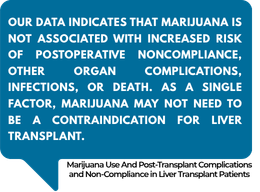
The current research does not support treating all medical cannabis use as an automatic barrier to transplantation. Reviews of the literature in heart and liver transplantation note that there is no clear national consensus and that programs continue to vary widely in how they evaluate cannabis use. The larger problem in the literature is not proof that cannabis exposure alone predicts transplant failure, but the absence of standardized policies and the persistence of center-to-center variation.
Several studies examining transplant outcomes have found no evidence that cannabis exposure alone leads to worse transplant outcomes. While reviews of transplant literature conclude that current evidence does not support treating cannabis exposure alone as a contraindication to transplantation, the transplant team may not have this information or may not have seen this research.
This research does not mean that cannabis medicines are risk-free. However, it should demonstrate to transplant teams that any concerns should be treated as clinical issues rather than as reasons to exclude patients from organ transplantation. When clinical evidence does not support the assumption that cannabis use is a contraindication to transplantation, decisions that still restrict access to a life-saving procedure are grounded in stigma rather than medical evidence. That is the essence of discrimination.
Discrimination against medical cannabis patients in transplant settings, as Patrick Navarro experienced, has been well documented. Research increasingly confirms that cannabis use influences access to transplantation. The lack of evidence supporting exclusion has led legal, ethics, and health policy scholars to increasingly recognize it as a form of healthcare discrimination.
Surveys of transplant clinicians reveal wide variation in how programs interpret cannabis use and apply it in transplant decision-making. As a result, patients with similar medical circumstances may face very different outcomes depending on which transplant center reviews their case.
An American Society of Transplantation survey found that approximately 28 percent of programs reported rejecting all candidates who used cannabis, while 52 percent indicated that their policies varied depending on the organ type or clinical circumstances. Programs also differed in their screening practices: 20 percent of programs did not screen for cannabis at all. 55 percent reported screening all candidates for cannabis use, while others screened selectively depending on organ type or clinical concerns.
Patients and families who experience transplant discrimination related to medical cannabis are encouraged to contact Americans for Safe Access. Shame is one of stigma’s most damaging effects. It can leave patients and caregivers feeling isolated and keep discrimination hidden from the people with the power to address it. They are not alone. Sharing experience not only shines a light on a problem many never see, it can also illuminate a path forward.
RESOURCES:
The organ transplant system in the United States is national but not uniform. Federal law established the framework for the modern transplant system, and the Organ Procurement and Transplantation Network, or OPTN, operates under federal oversight through the U.S. Department of Health and Human Services. OPTN helps coordinate the national transplant system, including organ allocation policies, waiting list structure, and member participation requirements.
What confuses many patients is that OPTN is not one giant national transplant program making every eligibility decision itself. It is the national network that oversees the transplant system, while individual transplant centers evaluate patients, decide whether to list them, and apply their own candidate-selection criteria within that broader framework. In other words, there is a national system, but there is not one single national rulebook for every decision made about every patient.
That distinction matters. HRSA’s OPTN ethics guidance states that transplant centers are encouraged to develop their own guidelines for transplant consideration, and that each potential candidate should be examined individually, and those guidelines should be applied without bias. Current materials show significant center-to-center variation rather than one settled approach. On one hand, this is positive because there is no national standard requiring blanket rejection or a six-month abstinence rule for all transplant candidates who use cannabis. It also means that two centers can review similar patients and reach different conclusions, especially when a policy area is not governed by a single national rule or required under federal law.
Variations in Cannabis Policies Across Transplant Programs
A transplant program’s cannabis policy — or lack of one — can affect referral, evaluation, waitlisting, active-list status, and transplant eligibility. Patients and caregivers should not assume all transplant centers treat medical cannabis use the same way. Surveys of transplant professionals and transplant programs have found significant variation in how cannabis is treated during candidate evaluation.
Blanket ineligibility: Some transplant programs effectively treat any cannabis use as disqualifying, regardless if there is evidence of actual clinical risk. In these programs, a positive THC test or disclosure of cannabis use may lead to denial of referral, evaluation, waitlisting, or continued eligibility. This is one of the most restrictive approaches because it treats cannabis as an automatic barrier rather than assessing the patient as an individual. For patients and caregivers, this approach is especially important to identify early, as it may require seeking evaluation at another center if possible.
Abstinence: Some programs do not automatically rule out transplant candidates who use cannabis, but they require a documented period of abstinence before the patient can be evaluated, placed on the waitlist, or restored to active status. In practice, this usually means drug testing and proof that THC is no longer detectable. These programs often treat cannabis use as a substance-abuse concern even when the patient is using it therapeutically.
This approach can create serious timing issues, as delaying evaluation or waitlisting can be dangerous for people with progressive organ disease. THC may remain detectable for 30 days or longer after cannabis use, and sometimes longer depending on the patient and pattern of use. Patients using cannabinoid products from the hemp market should also be aware that these products are often poorly regulated, and labels may be inaccurate. Even products labeled as containing 0% THC may still result in a positive THC test.
These programs may require continued compliance over time through repeated toxicology testing, substance-abuse assessments, counseling, or behavioral contracts.
Informal or unclear policy: Some programs do not appear to have a clear written cannabis policy, or they handle cannabis issues informally, depending on the clinician, coordinator, or committee involved. This can be one of the most frustrating approaches because patients may receive vague answers, inconsistent messages, or changing expectations over time. A center may say it handles cannabis “case by case,” but without written standards, that can still leave patients exposed to stigma, misunderstanding, or last-minute barriers. When a program’s approach is unclear, patients and caregivers should ask direct questions and request the policy or determination in writing whenever possible.
RESOURCE:
At the federal level, cannabis remains a Schedule I controlled substance even though HHS has already concluded that marijuana has a currently accepted medical use, and DOJ formally proposed rescheduling it in 2024. That contradiction is part of the problem. Until federal law recognizes medical cannabis in a way that aligns with accepted medical use, patients remain vulnerable to weaker protections and inconsistent treatment across healthcare systems, including transplant programs.
The fact that federal law remains out of step with state medical cannabis laws helps explain why many transplant centers still treat cannabis differently from other physician-directed therapies

At the state level, some protections do exist. Twenty states now provide some form of protection for medical cannabis patients facing potential transplant discrimination. In 13 of those states—Alabama, Arizona, California, Illinois, Kentucky, Missouri, New Hampshire, New Mexico, Ohio, Oklahoma, Rhode Island, Utah, and Washington—state law explicitly bars transplant centers from disqualifying a patient from needed medical care solely because of their medical cannabis use. The other 7 states rely on broader medical care or anti-discrimination provisions that may also apply to transplant decisions.
| STATE | LEGAL CITATION | BILL / ACT NAME | ORGAN TRANSPLANT CANDIDATE PROTECTIONS |
|---|---|---|---|
| AZ | A.R.S. § 36-2813(C) | 2010: Arizona Medical Marijuana Act | Medical-care protection: authorized use must be treated as the equivalent of other physician-directed medication & may not disqualify a patient from care, including organ transplants. |
| AR | Ark. Const. amend. 98, § 3 | 2016: Arkansas Medical Marijuana Amendment of 2016 | Broader patient-protection language has been used to support transplant-related protection. |
| CA | Cal. Health & Safety Code § 7151.36 | 2015: AB 258, Organ transplants: medical marijuana | Transplant-specific: transplant decisions may not be made solely on the basis of qualified-patient status or a positive test, absent a case-by-case finding of medical significance. |
| CT | Conn. Gen. Stat. § 21a-408p(b) | 2021: Public Act 21-1, Responsible & Equitable Regulation of Adult-Use Cannabis Act | Medical-care protection: cannabis use or metabolites may not be treated as illicit-substance use resulting in denial of medical care, including organ transplantation, & may be considered only using evidence-based clinical criteria. |
| DE | 16 Del. C. § 4905A(a)(2) | 2011: Delaware Medical Marijuana Act | Medical-care protection: lawful medical use is treated like any other medication & may not disqualify a patient from care, including organ transplants. |
| IL | 410 ILCS 130/40(a)(2) | 2019: Amendment to Compassionate Use of Medical Cannabis Program Act | Medical-care protection: lawful cannabis use does not constitute illicit-substance use & may not disqualify a person from medical care, including organ transplants. |
| KY | KRS § 218B.045(3) | 2024: HB 829 / Chapter 195, Medicinal Cannabis | Medical-care protection: authorized medicinal cannabis use is the equivalent of other practitioner-directed medication for purposes of medical care, including organ transplants. |
| ME | 22 M.R.S. § 2430-C | 2017: LD 764, An Act To Limit the Exclusion of a Patient from Eligibility for an Organ Transplant Based on Medical Marijuana Use | Transplant-specific: evaluators must treat medical cannabis like other provider-directed medication & may exclude a patient only if use is medically significant to the transplant. |
| MD | 2023 Md. Laws ch. 254 (HB 556) | 2023: HB 556 / Chapter 254, Cannabis Reform | Medical-care protection: cannabis use does not constitute illicit-substance use or otherwise disqualify an individual from needed medical care, including organ & tissue transplants, & may be considered only under evidence-based clinical criteria. |
| MA | Mass. Gen. Laws ch. 94G, § 7(e) | 2016: Regulating & Taxing Marijuana / Ch. 334 of the Acts of 2016 | The use of marijuana may not disqualify a person from any needed medical procedure or treatment, including organ & tissue transplants. |
| MN | Minn. Stat. § 342.57 | 2023: Chapter 342 recodification of Minnesota cannabis law | Medical-care protection: use of medical cannabis is treated as the equivalent of other medications & does not disqualify a patient from needed medical care, including organ transplants. |
| MO | Mo. Const. art. XIV, § 1(2) | 2018: Amendment 2, Medical Marijuana & Veteran Healthcare Services Initiative | Transplant-specific: "no patient may be denied access to or priority for an organ transplant because the patient holds a qualifying patient card or uses marijuana for medical purposes". |
| MT | Mont. Code Ann. § 16-12-107(9) | 2021: HB 701, Marijuana Regulation & Taxation Act implementation | Transplant-specific: a person may not be denied access to or priority for an organ transplant, or denied access to health care, solely for conduct permitted by the chapter. |
| NV | Nev. cannabis law (official legislative source linked) | 2019: AB 533, Nevada cannabis recodification | Broader medical-care & transplant-related nondiscrimination language is associated with Nevada’s medical-cannabis protections; linked source is the official 2019 recodification session law. |
| NH | N.H. Rev. Stat. § 126-X:2 | 2013: HB 573, Therapeutic Cannabis Program | Medical-care protection: authorized therapeutic cannabis use is treated as the equivalent of other medication & may not disqualify a patient from needed medical care, including organ transplants. |
| NJ | P.L. 2019, c.153, § 6(g) | 2019: Jake Honig Compassionate Use Medical Cannabis Act | Medical-care protection: authorized medical-cannabis use is treated as the equivalent of other medication & may not disqualify a qualifying patient from needed medical care, including organ transplants. |
| NM | N.M. Stat. Ann. § 26-2B-9 | 2007: Lynn & Erin Compassionate Use Act | Broader patient-protection language is commonly cited for medical care. |
| NY | N.Y. Cannabis Law § 127(3) | 2014: Compassionate Care Act / later recodified under New York cannabis law | Medical-care protection: a patient may not be denied medical care, including organ transplant; lawful medical use may be considered only with respect to evidence-based clinical criteria. |
| OH | Code § 3796.24(C) | 2016: HB 523, Medical Marijuana Control Program | Transplant-specific: lawful medical-marijuana use may not be used as a reason to disqualify a patient from medical care or from inclusion on a transplant waiting list. |
| OK | 63 O.S. § 425(C) | 2019: HB 2612, Oklahoma medical marijuana revisions | Broader patient-protection language is commonly cited for medical care |
| OR | ORS § 97.972(2)(b) | 2016: SB 29, transplant discrimination bill | Transplant-specific: a transplant hospital may not deny a recipient an anatomical gift solely because the recipient holds an Oregon medical cannabis registry card. |
| PA | 35 P.S. § 10231.2103 | 2016: Medical Marijuana Act / later cannabis nondiscrimination proposals | Pennsylvania has been cited for broader patient-protection language. |
| RI | R.I. Gen. Laws § 21-28.6-4 | 2016: Chapter 142, medical marijuana amendments | Medical-care protection: authorized use is treated as the equivalent of other physician-directed medication & does not constitute illicit-substance use for purposes of medical care, including organ transplants. |
| UT | Utah Code § 26B-4-214 (formerly § 26-61a-111) | 2018: Proposition 2 / later codified & renumbered in Utah medical-cannabis law | Broader medical-care protection: lawful medical-cannabis use may not be treated as illicit-substance use in medical care, including organ transplants. |
| WA | RCW 69.51A.110 | 2015: cannabis-law revisions to RCW 69.51A.110 | Transplant-specific: medical use may not be the sole disqualifying factor unless it poses a significant risk of rejection or organ failure; the law also preserves the ability to require a period of abstinence. |
None of these protections are uniform, and they do not always prevent transplant centers from invoking safety exceptions or exercising broad discretion that can function as a de facto denial. Patients should understand what protections exist under their state’s law, but they should not assume those laws will override a transplant center’s written or unwritten policy.
UNPACKING STIGMA IN TRANSPLANT CARE
One reason medical cannabis patients continue to face stigma in healthcare is the lack of professional education and clinical training on cannabis medicine. This gap persists even though medical cannabis is already part of everyday care in the United States. In one national clinician survey, 68.9% of respondents said cannabis has medicinal uses, but only 26.6% had ever recommended it to a patient. Other studies have reached a similar conclusion: many clinicians believe cannabis may help patients, but far fewer feel prepared to discuss dosing, delivery methods, risks, or clinical management with confidence.
Most medical training still does not include basic education about how cannabis works in the body, specifically the endocannabinoid system (a system of receptors that interact with cannabis that regulates pain, sleep, mood, appetite, and immune function), or about the therapeutic uses of cannabis. As a result, patients are often left explaining their own treatment to professionals who were never properly taught the underlying science. Accredited continuing medical education has also placed limits on how clinicians may be taught to recommend medical cannabis, including restrictions on practical instruction related to dosing, patient selection, and treatment integration.
Patients pay the price for that failure. When clinicians lack training, they may avoid the subject, rely on outdated assumptions, or respond to cannabis medicines with uncertainty or bias rather than informed clinical judgment.
Patients and caregivers should be prepared to explain why cannabis medicines are part of the patient’s treatment plan and to share educational resources. Americans for Safe Access created an additional supplement to Stigma with a Body Count for transplant teams, titled Ethically Indefensible: Neuropathic Pain, Medical Cannabis & Organ Transplant Eligibility , to address this educational gap.
RESOURCES:
FDA-Approved Drugs for Neuropathic Pain Chart (on page 6 of Ethically Indefensible )
Ethically Indefensible: Neuropathic Pain, Medical Cannabis & Organ Transplant Eligibility
A persistent problem in the creation and implementation of transplant center policy is a holdover view from cannabis prohibition that all use is abuse. That legacy still influences transplant decision-making today, particularly when clinicians or transplant programs treat medical cannabis use as presumptive evidence of instability or substance disorder rather than examining the clinical context of a patient’s treatment.
This view has been perpetuated in an extremely broad diagnostic framework of Cannabis Use Disorder (CUD) included in the Diagnostic and Statistical Manual (DSM) of mental disorders. This framework does not distinguish between recreational, problematic, or therapeutic cannabis use. As a result, many patients using cannabis to manage symptoms such as chronic pain, nausea, spasticity, or sleep disorders meet the criteria associated with CUD despite stable, medically appropriate, and supervised use.
It may seem obvious that medical use is not the same as substance-abuse disorder, but not all healthcare professionals have been educated on how to distinguish physician-directed therapeutic use from clinically significant substance-use disorder. As a result, many clinicians assume that cannabis use means addiction, misuse, or likely non-adherence after transplant. Patients and caregivers should be prepared to explain the role cannabis plays in the patient’s treatment plan Patients and caregivers should come to initial meetings with documentation showing both the patient’s legal authorization to use cannabis medicines and the clinical reasons those medicines are part of the patient’s regimen, using resources such as ASA’s Cannabis Medicine Log.
RESOURCE:
The most credible clinical concerns in the transplant setting are product safety and drug interactions. These risks are real considerations in transplant medicine, but the available evidence suggests that they are best addressed through clinical management rather than categorical denial of transplant eligibility.
CONTAMINANTS
One of the most concrete concerns among transplant teams involves contamination of cannabis products with microbial pathogens. Transplant recipients and candidates are often immunocompromised, which increases their susceptibility to opportunistic infections. Case reports dating back several decades have documented invasive aspergillosis associated with inhalation of contaminated cannabis in immunocompromised patients.
Cannabis is generally regarded as safe, but that assessment does not extend to contaminated products, highly processed extracts, or products containing additives whose inhalation safety has not been established. Cannabis products may be contaminated during cultivation, manufacturing, handling, and storage, and some manufactured products may include excipients, carrier oils, flavoring agents, or concentrated terpene blends that pose distinct safety concerns.
WHOLE PLANT VAPORIZATION VS VAPE PENS
Whole-plant vaporization and vape-pen inhalation should not be treated as interchangeable. Medical vaporization of whole-plant cannabis involves heating cannabis flower to release cannabinoids and terpenes without combustion and without the thinning agents commonly found in cartridges. Vape pens and cannabis oil cartridges may contain additional excipients, carrier oils, flavoring agents, and concentrated terpenes whose inhalation safety may be uncertain, especially when heated. For immunocompromised patients, including transplant recipients, this distinction is clinically important.
In recent years, most state-regulated cannabis programs have adopted increasingly stringent microbial testing requirements designed to address these risks more directly. Numerous states now require testing for pathogenic Aspergillus species, particularly for inhalable cannabis products, as well as testing for microbial contaminants such as Salmonella, Escherichia coli, and total yeast and mold counts.
DRUG INTERACTIONS
Another commonly cited concern involves potential interactions between cannabinoids and immunosuppressive medications used after transplantation. Studies have shown that cannabidiol (CBD), in particular, can influence how those medicines are metabolized. Drug-to-drug interactions are not unique to cannabis. Transplant clinicians routinely manage interactions involving antifungal medications, antibiotics, cardiovascular drugs, and numerous other therapies that can influence immunosuppressant metabolism. In this context, cannabinoid interactions represent a manageable pharmacological issue rather than a categorical contraindication.
VERIFY SAFETY
Cannabis products are now available across the U.S. in many forms from a variety of markets. So, you may be surprised to learn that not all of these products have undergone comprehensive safety evaluations or testing for contaminants, harmful additives, and adulterants. Patients and their caregivers should always be vigilant about product safety.
One way is to purchase cannabis medicines from regulated cannabis markets, which is not a 100% guarantee of safety, but products from the hemp and illicit markets are not required to be tested at all. Another way is to review a product’s Certificates of Analysis (COAs), which help ensure the product has been tested and provide a better understanding of its contents. If cannabinoid/terpene content or claims of contaminant levels are on a label, the product manufacturer should be able to back this data up with a COA. It is important to note that acceptable levels of contaminants vary in all cannabis markets. Use the resources below to find regulated products and learn more about COAs.
RESOURCES:
ADVOCATING FOR CANNABIS PATIENTS IN THE TRANSPLANTATION SYSTEM
Americans for Safe Access created the checklist on page 13 to help patients and caregivers determine if a transplant program is appropriate for the patient, prepare for transplant evaluations, document medical use clearly, and respond to discrimination if needed.
NOTE: The physician who is referring the patient for transplantation may not be aware of discrimination in transplant programs.
First, use ASA resources to determine whether your state has legal protections for medical cannabis patients seeking organ transplants. Because these laws vary from state to state, patients and caregivers should read the actual statute and be prepared to cite it. But legal protections on paper do not always guarantee fair treatment in practice. ASA has found that some transplant programs still find ways around these laws, which is why careful research into individual centers remains essential.
Complete List of Organ Transplant Laws: https://www.safeaccessnow.org/guide_to_organ_transplants
A center’s cannabis policy can impact a patient’s access to eligibility evaluations, waitlisting, and active-list status. If possible, ask the referring physician whether there are multiple centers available for the needed organ transplantation, if any of them are known to work with medical cannabis patients, or if they have knowledge of one being more flexible than another.
Patients and caregivers should inquire with each transplant center about their medical cannabis policies and get them in writing if possible . If they say they do not have a formal policy, ask if they reject candidates who test positive for THC, or if they require patients to abstain from medical cannabis use, and if so, for how long, and how they enforce this.
Start by reviewing the program’s website and any posted eligibility criteria. If cannabis is not mentioned, contact the program directly and ask for its policy on medical cannabis use. Whenever possible, ask for the policy in writing.
Patients and caregivers should ask specifically:
- Does the center require abstinence before referral, evaluation, or waitlisting?
- Can a positive THC test result in delay, inactivation, or denial?
- Does the program distinguish lawful medical use from substance-use disorder?
- Are there written standards, or is cannabis handled informally?
- Does the policy apply differently to THC, CBD, inhaled products, edibles, tinctures, or hemp-derived products?
See pages 4 & 5 for more info on transplant center polices.
GETTING ANSWERS UP FRONT CAN PREVENT DELAYS, AVOID SURPRISE DRUG-TESTING PROBLEMS, & HELP FAMILIES CHOOSE THE MOST SUITABLE OPTION.
Center selection and vetting are extremely important, especially if a patient is actively using medical cannabis. THC may remain detectable for 30 days or longer after cannabis use, and sometimes longer depending on the patient and pattern of use. Patients using cannabinoid products from the hemp market should also be aware that these products are often poorly regulated, and labels may be inaccurate. Even products labeled as containing 0% THC may still result in a positive THC test.
If all the transplant programs available have blanket ineligibility or strict abstinence policies, then talk to the referring physician about scheduling the transplant evaluation at a time when the patient can pass a drug test, other treatment options to replace medical cannabis, and, if it is necessary to disclose to the transplant center, past use of medical cannabis. Your physician may also be able to point to other options, including out-of-state care. For a list of states that recognize out-of-state medical cannabis patients, visit SafeAccessNow.org/Travel .
No matter what a transplant center’s policy says about medical cannabis, transplant teams are likely to have questions about a patient’s use during the evaluation process. Surveys of transplant professionals show ongoing concerns about product safety, substance abuse, and other possible contraindications . Having organized documentation can help alleviate the transplant team’s fears by demonstrating that cannabis is being used responsibly as part of a symptom-management plan.
The checklist identifies materials to gather before the evaluation meeting. It points to documents that can be printed or uploaded and highlights information to help answer common questions from the transplant team. The resources below can help patients and caregivers locate the materials referenced in the checklist and begin building a medical cannabis file for the evaluation team.
Patients and caregivers should also be prepared for the transplant team to ask whether the patient can stop using cannabis during the transplant process, including after surgery. That possibility should be considered in advance, and patients should not feel pressured to agree to something that is not medically or practically feasible. What may seem like a simple request to the transplant team may not be realistic for the patient. If cannabis medicine is no longer an option, how will pain, inflammation, or other symptoms be managed? Is abstaining medically appropriate and practically possible, particularly if the patient will likely be drug tested after agreeing to stop?
Patients and caregivers should expect questions about medical cannabis use that may or may not stem from stigma. Try not to become defensive. Many transplant professionals may have limited knowledge about cannabis medicines and transplantation beyond internal program policy. The goal is to answer clearly, calmly, and in a way that brings the conversation back to medical facts, safety, and adherence.
Practice discussing some of these topics before your evaluation.
- Why cannabis is being usedan what symptoms it helps manage
- who recommended or oversees that treatment, if applicable
- What product is being use and how often it is used
- the difference between products from regulated and unregulated market
- the difference between whole-plant vaporization and oil cartridges or vape pens
- products are tested for contaminants and certificates of analysis are available
- Whole-plant vaporization is not the same as smoking contaminated material: regulated flower is not the same as an unregulated cartridge
The key issue is not to argue that every route is equally appropriate in every case. The key issue is to demonstrate that the product type, safety, and symptom-management goals have been carefully considered. Patients should disclose all cannabinoid products they use, including CBD. Transplant teams may need to monitor immunosuppressant levels carefully if cannabinoid products are part of the patient’s treatment. That is especially important when CBD is involved.
Interaction concerns should be treated as monitoring issues, not as automatic reasons for denial. Patients should make clear that they want the team to know what they are using so medication levels and safety can be managed appropriately.
STATE MEDICAL CANNABIS LAWS
Use this resource to find state medical cannabis laws, qualification requirements, and product testing standards.
COMPLETE LIST OF ORGAN TRANSPLANT LAWS
www.safeaccessnow.org/guide_to_organ_transplants
Use this resource to review state laws related to transplant protections and discrimination.
CANNABIS MEDICINE LOG
www.safeaccessnow.org/Keeping_Cannabis_Medicine_Log
Use this tool to document cannabis use, symptom management, and treatment patterns.
PATIENTS AND CAREGIVERS SHOULD TRY TO DOCUMENT:
- the medical reason cannabis is being used
- the healthcare professional involved in the treatment plan, if any
- the product being used
- route of administration
- package labels or certificates of analysis, when available
- efforts to use regulated, contaminant-tested products
- other medications being used for the same condition
- whether standard therapies failed or caused unacceptable side effects
INFORMATION ON CANNABIS MEDICINES
www.safeaccessnow.org/cannabis_therapeutics
Use this resource for background information on cannabis medicines and therapeutic use.
ASA SUPPORTING DOCUMENTS:
Ethically Indefensible: Neuropathic Pain, Medical Cannabis & Organ Transplant Eligibility
www.safeaccessnow.org/resources_for_transplantation_programs
Stigma with a Body Count
www.safeaccessnow.org/stigma_with_a_body_count
Medical Professionals, Medical Cannabis, & the Law
www.safeaccessnow.org/medical_professionals
Patients should answer questions about medical cannabis clearly and calmly. There is nothing wrong or illegal about discussing lawful medical cannabis use, and patients should not let shame or defensiveness shape the tone of the meeting. Let the documents from the checklist guide the conversation. Do not assume the transplant team already has this information or understands the patient’s full treatment history.
It is important to remember that many medical professionals have received little or no formal education on cannabis therapeutics or the endocannabinoid system. Information about medical cannabis use, treatment goals, and product safety should be presented the same way any patient would discuss other treatment options. Ask the transplant team if they have any concerns about medical cannabis and organ transplants. The goal is to address any of the transplant team’s reservations with clear medical evidence, documentation of responsible use, and assurance of compliance with monitoring requirements.
Some of the transplant team’s concerns may be clinically grounded, while others may reflect lingering stigma or assumptions that cannabis use signals substance abuse that could result in poor adherence to post-transplant care. Presenting the materials in the checklist can go a long way toward addressing those concerns and shifting the conversation back toward medical evidence rather than bias.
When a transplant center delays, denies, or inactivates a patient because of medical cannabis, documentation should be the next step. A written record can help families understand whether the decision reflects a formal policy, a discretionary judgment, or possible discrimination. It can also support appeals, referrals to other centers, and reporting to Americans for Safe Access so that these experiences are not buried behind internal policies or unwritten rules.
If you believe a patient was denied transplant evaluation, waitlisting, active-list status, or transplant-related services because of lawful medical cannabis use, document what happened as clearly as possible.
Try to collect:
- the name of the transplant center
- dates of key conversations or decisions
- written policy language, if available
- drug-testing requirements
- statements linking cannabis use to delay, denial, or inactivation
- records showing the cannabis use was lawful and medical in nature
Ending stigma means making discrimination visible. Hidden discrimination has a nasty habit of dressing up as “policy.”
Patients and families experiencing transplant discrimination related to medical cannabis are encouraged to report the case to Americans for Safe Access through the intake form at www.safeaccessnow.org/Organ_Transplant_Discrimination_Form .
Patients and families who experience this kind of discrimination are encouraged to contact Americans for Safe Access. Shame is one of stigma’s most damaging effects. It can leave patients and caregivers feeling isolated, but you are not alone. Sharing your experience can help expose a problem many never see and illuminate a path forward.
REPORT SUSPECTED DISCRIMINATION:
Federal medical cannabis reform is not just about access to treatment. It is about defining cannabis as medicine so that legal and policy gaps no longer allow discrimination to persist. State protections matter, but without federal law to back patient rights and protections, medical cannabis patients will continue to face stigma and bias in healthcare.
Most discrimination happens out of the view of the public including those who have the power to make meaningful change. When patients and families document stigma, report discrimination, and share their experiences, they help expose a system that too often escapes scrutiny.
RESOURCES:
Report suspected discrimination . www.safeaccessnow.org/organ_transplant_discrimination_form
Take Action: www.safeaccessnow.org/Take_Action
Donate: www.safeaccessnow.org/Donate
Medical cannabis patients should not lose access to life-saving transplant care because transplant systems confuse therapeutic use with substance misuse or because one center’s internal policy overrides individualized medical judgment. The national transplant system is real, but many of the decisions patients encounter first are still made at the transplant center level. Until stronger federal protections and clearer clinical standards are in place, patients and caregivers need to enter the process informed, organized, and prepared to ask direct questions early.
For more information on organ transplants & Americans for Safe Access, visit:

Share this page