 The DEA marijuana (cannabis) scheduling hearing has created a lot of confusion for patients, caregivers, advocates, businesses, and state regulators.
Some people are asking why so many anti-cannabis voices are testifying. Others are treating the hearing as if it could legalize adult-use cannabis or replace the need for DEA registration. Some regulators appear to be waiting for the hearing instead of helping eligible medical cannabis businesses prepare for the new federal medical cannabis pathway.
This FAQ includes information medical cannabis stakeholders need to know, including what the hearing can and cannot do, and why we need to act now (not after the hearing) to protect and expand safe access.
No.
AG Order No. 6754-2026 created a federal medical cannabis pathway for FDA-approved marijuana products and certain medical marijuana products regulated under qualifying state-issued medical cannabis licenses.
The DEA hearing is about the broader proposed rule to move the remainder of cannabis from Schedule I to Schedule III under the Controlled Substances Act. These are related, but they are not the same. The hearing should address broader scheduling.
ALJ Julius’s order states that the hearing will not address the rescheduling of FDA-approved medical products that contain marijuana or medical marijuana products already regulated by the states. Instead, the hearing will focus on whether the remainder of cannabis, as defined in the CSA, should be transferred from Schedule I to Schedule III.
Although positive for patients in the short term, this raises serious concerns for U.S. scheduling law. Schedule I is reserved for substances with no currently accepted medical use. If cannabis has a currently accepted medical use, it cannot remain in Schedule I. Cocaine and methamphetamine remain tightly controlled, but they are not in Schedule I because they have accepted medical uses and are only legal with a DEA registration.
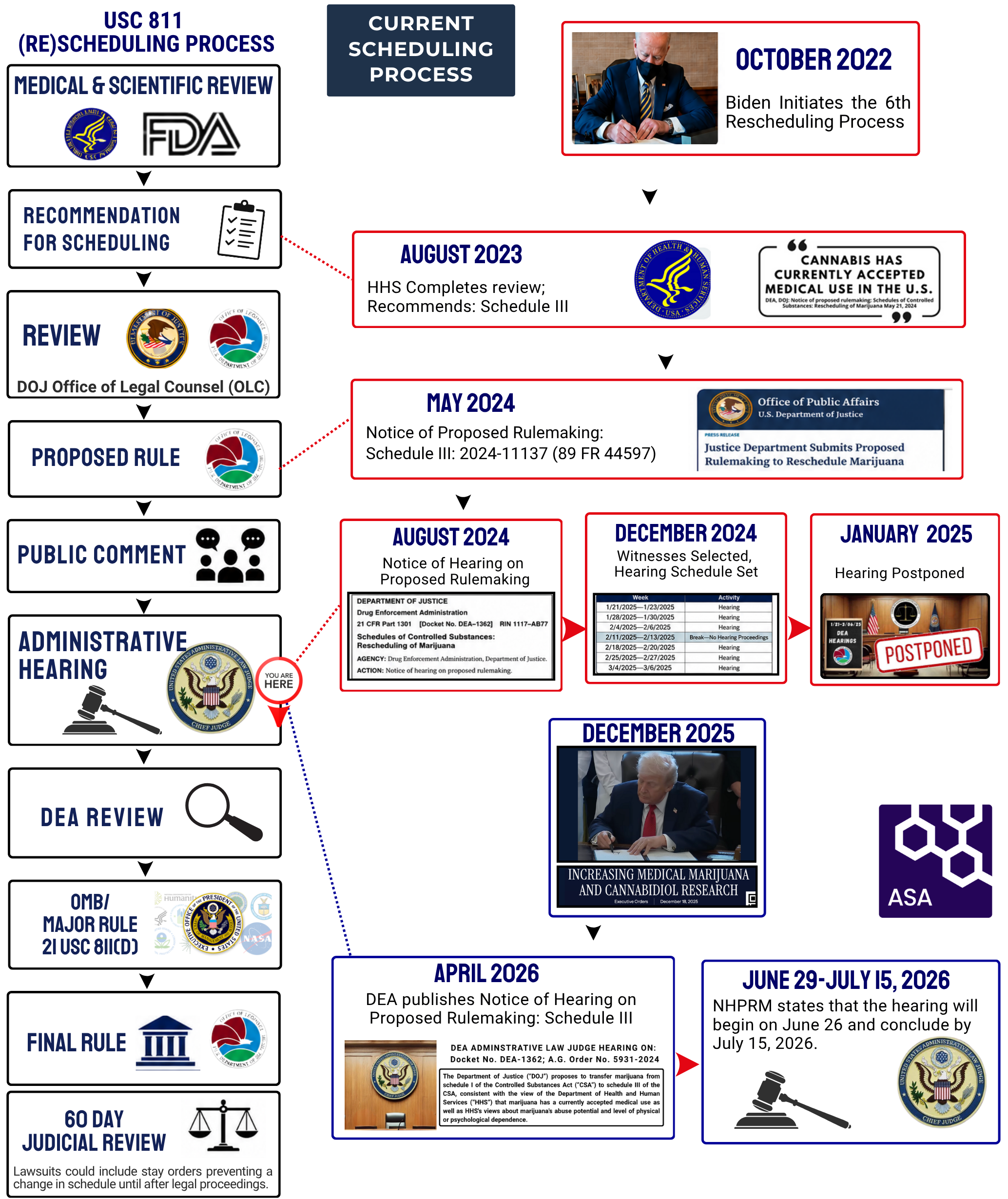
The hearing is part of the marijuana scheduling process President Biden initiated in October 2022, when he directed federal agencies to review marijuana’s status under the Controlled Substances Act.
In August 2023, HHS completed its scientific and medical review and recommended moving marijuana to Schedule III. In May 2024, DOJ published a proposed rule to transfer marijuana from Schedule I to Schedule III.
That process stalled after procedural fights and delays in the earlier DEA administrative hearing. On April 28, 2026, the Department of Justice announced steps the DEA had taken to expedite a separate process to consider broader marijuana rescheduling from Schedule I to Schedule III. DEA withdrew the prior notice of hearing, terminated those proceedings, and started a new hearing process intended to move more quickly.
These actions were taken in response to President Trump’s December 18, 2025, Executive Order, “Increasing Medical Marijuana and Cannabidiol Research.” That order directed the Attorney General to take all necessary steps to complete the process of rescheduling marijuana to Schedule III of the Controlled Substances Act “in the most expeditious manner” consistent with federal law, including 21 U.S.C. § 811(d).
Patients who want a broader overview of what has changed can read ASA’s blog, Is Cannabis (Marijuana) Legal Now?
DEA is the government proponent of the proposed rule. That means DEA will be defending the proposed transfer of marijuana from Schedule I to Schedule III.
Considering the DEA’s long history of resisting cannabis rescheduling, advocates have reason to be wary. But reporting on DEA’s filings indicates that DEA’s witnesses are expected to support the federal scientific and regulatory basis for Schedule III.
That includes testimony about HHS and FDA’s eight-factor analysis, the federal finding that cannabis has a currently accepted medical use, and the federal assessment of marijuana’s abuse potential and dependence profile.
Patients should not mistake the presence of opposition witnesses for the government changing sides. DEA is not convening a public opinion forum. DEA is defending the proposed scheduling action.
DEA has identified witnesses expected to support the Schedule III proposal.
Dr. Corey Burchman, a New Hampshire physician with more than 30 years of medical practice experience, is expected to testify as a medical expert in pain management and discuss clinical experience with the use of medical cannabis.
Dominic Chiapperino, Director of the Controlled Substance Staff at FDA’s Center for Drug Evaluation and Research, is expected to testify about the federal eight-factor analysis used to assess cannabis’ currently accepted medical use in treatment in the United States.
Many patients are understandably frustrated by the witness list. It includes organizations and individuals focused on workplace drug testing, drugged driving, law enforcement, anti-marijuana advocacy, and states opposed to the proposed rule.
But under the Controlled Substances Act, administrative hearings are not designed to include every stakeholder or create a balanced cross-section of the cannabis debate. The process is built around parties who claim they are adversely affected or legally aggrieved by the proposed scheduling action.
In plain English, the hearing is structured largely for parties objecting to Schedule III, not every organization that supports moving marijuana out of Schedule I.
That is why the witness list includes groups such as the National Drug & Alcohol Screening Association, the Tennessee Bureau of Investigation, Smart Approaches to Marijuana, states challenging the rule, drugged-driving victim advocates, and medical or pharmacy professionals raising safety, labeling, impairment, or procedural concerns.
The hearing witness list has caused understandable concern among patients because many of the selected interested parties oppose moving marijuana to Schedule III or want the proposed rule narrowed, delayed, or overturned.
That does not mean these parties represent patients. It means they claim they would be harmed, adversely affected, or legally aggrieved by the proposed scheduling action.
The National Drug & Alcohol Screening Association
The National Drug & Alcohol Screening Association focuses on workplace drug testing, drug-free workplace policy, transportation safety, and drug and alcohol screening services.
The expected witnesses include Patrice Kelly, a former Department of Transportation official, and Executive Director Jo McGuire. The organization is expected to argue that the rescheduling proposal failed to address unintended safety impacts, especially for transportation safety and workplace testing.
Their focus is impairment, transportation, workplace rules, and testing policy.
Tennessee Bureau of Investigation
The Tennessee Bureau of Investigation, or TBI, is a state law enforcement agency. Its proposed witness is Erica Stephens, Assistant Special Agent in Charge of the Tennessee Dangerous Drugs Task Force.
TBI argues that rescheduling would adversely affect its operations because the agency investigates and enforces drug-related offenses and processes large numbers of drug submissions through forensic crime laboratories. TBI also claims the proposed rule could affect its public safety mission, especially because Tennessee is a transportation and logistics hub bordering eight states.
TBI’s participation shows how law enforcement agencies may frame Schedule III as an operational and public safety burden, even though patient access and medical use are the central reasons marijuana no longer belongs in Schedule I.
Smart Approaches to Marijuana
Smart Approaches to Marijuana, or SAM, is an anti-marijuana advocacy organization. SAM says it works to align marijuana policy with scientific understanding of marijuana’s harms and opposes commercialization and normalization.
SAM argues that moving marijuana to Schedule III would reduce restrictions on access, require the organization to divert resources, and force it to spend money on new advocacy and education efforts, especially around youth prevention and public health.
SAM’s proposed or requested witnesses include Luli Akinfiresoye, a DEA pharmacologist, and Bertha Madras, former White House Office of National Drug Control Policy official.
SAM is expected to argue that marijuana has a high potential for abuse, no currently accepted medical use, and lacks accepted safety for use under medical supervision. That is the argument for keeping marijuana in Schedule I.
SAM’s participation is not surprising. SAM is using the hearing to argue against Schedule III and to keep federal policy focused on harms, youth use, normalization, and commercialization.
Nebraska, Idaho, and Indiana
Several states have opposed the federal scheduling action and pursued related legal challenges. Nebraska, Idaho, and Indiana are among the states identified as interested parties.
These states argue that the federal action is procedurally improper, inconsistent with the Controlled Substances Act and the Single Convention on Narcotic Drugs, and arbitrary and capricious under the Administrative Procedure Act.
Their expected witnesses include Dr. Deepak Cyril D’Souza, who is expected to testify about cannabis abuse liability, and Sheriff William Honsal of Humboldt County, California, who is expected to testify about illicit marijuana markets.
These states are not arguing from a patient-access framework. Their objections focus on procedure, treaty compliance, potential for abuse, enforcement concerns, and the relationship between legal and illicit markets.
DUID Victim Voices
DUID Victim Voices represents people affected by drugged driving. Its work focuses on drug-impaired driving policy, laboratory testing, per se drugged-driving laws, and victim perspectives.
The organization argues that state drugged-driving laws are inconsistent and often harder to enforce than alcohol DUI laws. It also argues that THC limits are an inadequate substitute for broader drug per se laws.
Medical cannabis patients should never drive impaired. But impairment policy should not be used to erase the medical use of cannabis or keep patients trapped in Schedule I.
Kenneth Finn, MD
Dr. Kenneth Finn is a physician who practices comprehensive pain medicine. He argues that the federal action harms him as a practitioner because state-licensed dispensaries may dispense marijuana without the standardized dosing protocols, package inserts, drug interaction data, and FDA-approved labeling that ordinarily accompany Schedule III controlled substances.
Phillip Drum, PharmD
Phillip Drum is a pharmacist who has raised concerns regarding pharmacy ethics, controlled-substance responsibilities, investigational drug standards, product safety, and patient counseling. He has also raised concerns about veterans, PTSD, oncology patients, HIV/AIDS patients, immunocompromised patients, drug interactions, product contamination, recalls, smoked products, driving impairment, and roadway safety.
These witnesses raise concerns that are shared by many medical professionals, patients, and caregivers. ASA acknowledges that clinicians and pharmacists need better product information, dosing guidance, drug-interaction data, labeling, education, and product standards while still rejecting the idea that those gaps justify keeping cannabis in Schedule I or blocking patient access.
We should not panic because many interested parties oppose Schedule III. That is how this kind of administrative hearing works. The witness list is shaped by objections and claimed legal injury, not by the size of the patient community or the strength of public support for medical cannabis.
However, we should pay attention. Many of these parties are using real public concerns, including impaired driving, youth access, product safety, workplace safety, labeling, potency, contamination, and illicit markets, to argue against rescheduling.
As a community, we should not dismiss those concerns. We know the answer is to regulate medical cannabis properly, protect patients, require clear product standards, educate clinicians, preserve medical-only supply chains, and stop pretending Schedule I is a public health policy.
Schedule I has not protected patients. It has blocked research, disrupted care, denied rights, and forced medical cannabis policy into a legal contradiction for decades. The solution is not to keep cannabis trapped in Schedule I. The solution is to build the medical cannabis framework patients have always needed.
No.
This hearing is narrower than many headlines suggest. The hearing is not supposed to revisit the rescheduling of FDA-approved marijuana products or medical marijuana products already regulated by qualifying state medical cannabis systems. That has already been addressed under AG Order No. 6754-2026.
The hearing is focused on whether the remainder of marijuana, as defined under the Controlled Substances Act, should be transferred from Schedule I to Schedule III.
That distinction matters because some cannabis businesses are treating the ALJ hearing as if it might legalize adult-use cannabis or give all cannabis businesses the same benefits they would receive from DEA registration. That is dangerous and wrong.
ASA has warned that misguided notions about the ALJ hearing are putting cannabis businesses and patients at risk.
No.
Schedule III is still part of the Controlled Substances Act. Moving marijuana to Schedule III would mean the federal government no longer treats marijuana as a substance with no currently accepted medical use. That is a major medical and legal shift.
But Schedule III substances are still controlled substances. Businesses that manufacture, distribute, dispense, or handle Schedule III substances generally must operate within federal registration and regulatory requirements.
Rescheduling is not legalization. It is not a free pass. It is not federal adult-use legalization in a lab coat.
Yes & No.
Under the new federal medical framework, current state medical cannabis registration, certification, or similar documentation may help distinguish therapeutic use from non-medical use. It may also matter when patients seek individualized review, reasonable accommodation, housing protection, healthcare access, employment protection, education access, or other rights tied to medical cannabis status.
Patients who rely only on adult-use stores, hemp-derived products, or expired medical registrations may not have the documentation they need to benefit from the new federal medical cannabis framework.
Patients can use ASA’s guide, Claim Your Federal Protections & Privileges, to learn what has changed, why staying registered matters, and how to begin asserting their rights.
Because delayed, edited access is not the same as public access. A one-way livestream or listen-only feed would expand transparency without interfering with the hearing.
DEA has said the hearing will be open to the public and media in a limited capacity, and that a finalized, corrected transcript will be posted after the proceedings. However, unlike court proceedings, the transcript will not capture everything said during the hearing. It will include only what a judge decides should go in the record.
While it is always true that patients should not be excluded by geography, disability, or income, the limited courtroom capacity in this case means that only the audience in the room will ever know what happened at these hearings.
ASA and other patient advocates asked the DEA Administrative Law Judge to reconsider the ban on livestreaming the marijuana rescheduling hearing.
The DEA hearing is expected to conclude on July 15, 2026, but there is no specific deadline for Chief Administrative Law Judge Derek C. Julius to issue his recommendation.
It is also important for patients to understand that the DEA is not legally bound by the ALJ’s recommendation. The last major DEA administrative hearing on cannabis scheduling concluded in 1985, when Administrative Law Judge Francis Young found that it would be arbitrary and capricious for the DEA to continue standing between patients and access to medical cannabis. DEA rejected that recommendation and continued to keep cannabis in Schedule I.
After the ALJ issues a recommendation, the DEA Administrator will review the hearing record, the ALJ’s findings, public comments, and the federal scientific and medical analysis. DEA will then decide whether to issue a final rule.
DEA could finalize Schedule III, modify the proposed scheduling decision to Schedule II, or attempt to leave marijuana in Schedule I. Keeping marijuana in Schedule I would invite serious legal and scientific challenges because it would conflict with the federal accepted-medical-use finding.
Once the DEA issues a final rule, it can take effect, but it will also be subject to a 60-day judicial review period.
During that time, parties may file lawsuits challenging the decision or the process used to reach it. A lawsuit does not automatically stop the rule from taking effect, but a court could issue a stay or other order delaying implementation while the legal challenge proceeds.
Stakeholders should expect litigation. That is not a reason to stop organizing. It is a reason to keep building state and federal protections now.
Not by itself.
Patient rights are connected to a broader legal and policy framework, including federal disability, housing, healthcare, civil rights, and state medical cannabis laws.
AG Order No. 6754-2026 changed the legal foundation by recognizing certain medical cannabis activity instead of treating all cannabis as Schedule I contraband. But rights are not self-executing.
Patients still need federal agency guidance, state implementation, legal advocacy, education, and enforcement. ASA’s position is clear: rights are real, but patients need agencies and states to stop acting as if they were optional.
Patients can start with ASA’s guide, Claim Your Federal Protections & Privileges.
No.
Schedule III will not provide immediate access to every patient in every state. It will not legalize adult-use cannabis. It will not eliminate the need for state action, federal guidance, DEA registration, medical supply-chain documentation, or congressional reform.
But Schedule III would create a powerful foundation for Congress to go beyond AG Order No. 6754-2026 and establish a national medical cannabis access program.
Now that the federal government has recognized cannabis as having currently accepted medical use, patients should not have to rely on expensive, exhausting court battles to secure access to medicine. Congress should act to create a clear, durable federal access pathway that protects patients no matter where they live.
Stakeholders can tell Congress to create a national medical cannabis access program.
Do NOT wait for the hearing to end before taking action.
Know your status and claim your federal protections. Keep your medical cannabis registration current if your state has a medical cannabis program. Patients who left medical programs because adult-use or hemp access was easier should consider re-enrolling.
Ask your state what it is doing to protect access to medical cannabis. The key questions are simple: Is the state helping eligible medical cannabis businesses seek DEA registration? Is the state issuing verification letters? Is the state preserving medical-only supply chains? Is the state educating patients? Is the state making registration affordable, confidential, and accessible?
Tell Congress to create a national medical cannabis access program.
Keep pressure on President Trump and federal agencies to protect patient rights.
Medical cannabis patients have spent decades fighting for federal recognition. Now they need to use that recognition to secure real access, real protections, and real accountability.
But patients should not let hearing become the only thing they focus on. The medical pathway already exists. The urgent work is making sure patients can actually use it.
Federal recognition is a historic opening. State action is what turns it into patient protection in the short-term, but it is up to Congress to integrate cannabis into our healthcare system, making access possible for every patient.
Stakeholders can support ASA’s work to protect medical cannabis access, patient rights, and federal implementation by becoming a member, donor, or sponsor of Americans for Safe Access.

Share this page