Patient Organizations Hail Partial Victory in DOJ Budget Medical Cannabis Protections
 Immediate Release
July 14, 2025
Patient Organizations Hail Partial Victory in DOJ Budget Medical Cannabis Protections
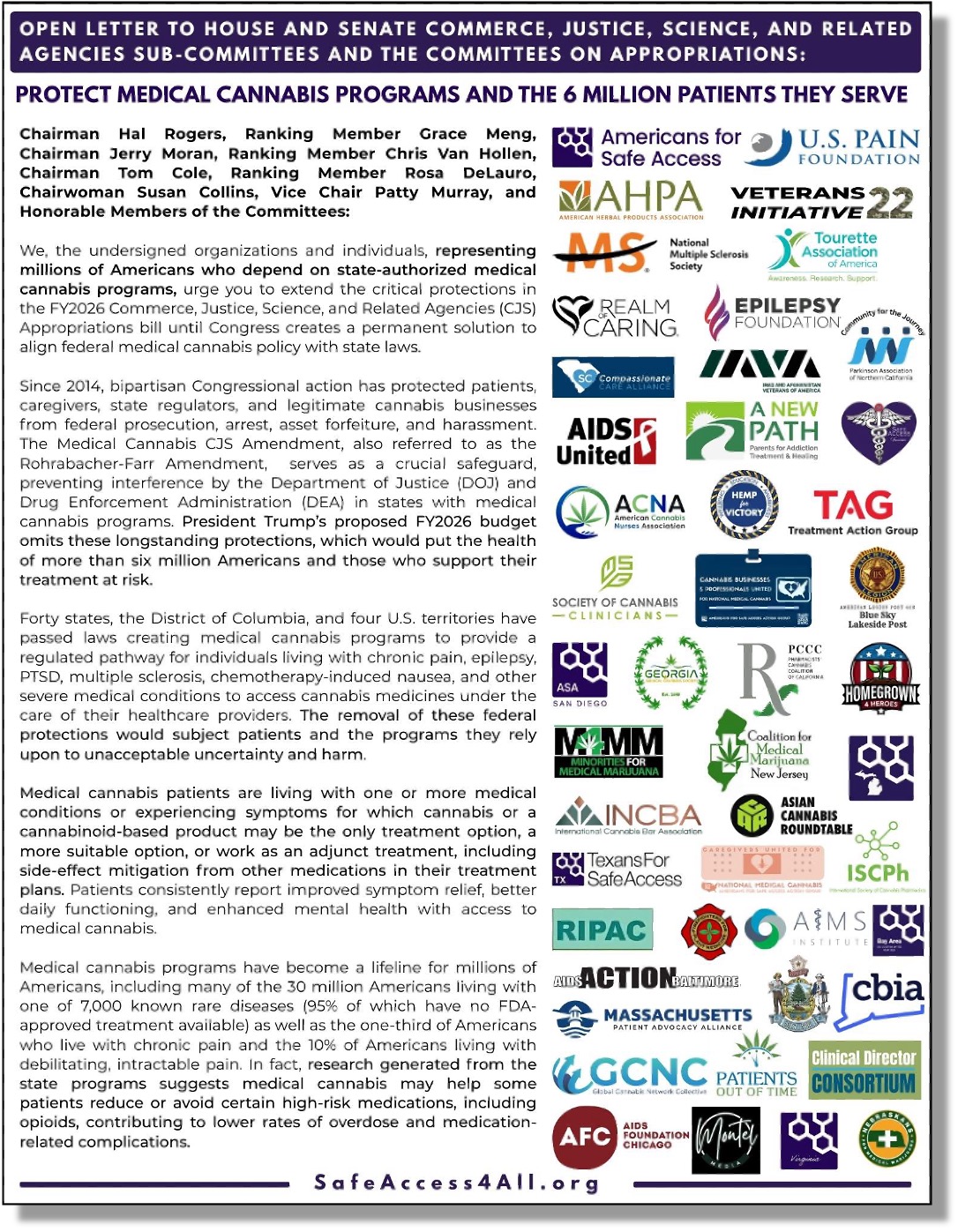
Washington, D.C. — Today, the CJS Appropriation Committee went against President Trump's proposal to omit protections for state medical cannabis laws. A coalition of 45 national and state-based organizations representing millions of patients, healthcare professionals, veterans, and caregivers announced a joint letter to congressional appropriators, urging them to preserve crucial protections for state medical cannabis programs in the upcoming FY2026 Commerce, Justice, Science, and Related Agencies (CJS) Appropriations bill claim a partial victory.
Addressed to Chairman Hal Rogers, Ranking Member Grace Meng, Chairman Jerry Moran, Ranking Member Chris Van Hollen, and other key members of Congress, the letter calls on lawmakers to extend the longstanding provision, the Medical Cannabis Amendment—commonly known as the Rohrabacher-Farr Amendment—which prevents the Department of Justice (DOJ) and Drug Enforcement Administration (DEA) from interfering in state-authorized medical cannabis programs.
“You have the power to protect the health, safety, and dignity of millions of Americans,” the letter states. “Until permanent federal legislation is enacted, maintaining the Medical Cannabis CJS Amendment is essential.”
CJS FY2026 Commerce, Justice, Science, and Related Agencies (CJS) Appropriations bill is now scheduled for markup at 12 pm ET
While the bill includes the traditional protections from the former bills, it has added
(b) Funds made available under this Act to the Department of Justice may be used to enforce violations of 21 U.S.C. 860.
This addition could be a poison pill for access for many patients. While most state legal medical cannabis businesses conform to state-sensitive use rules (i.e., 600 feet from a school), the provisions in the inserted language would allow raids on any facilities that don't conform to parameters listed in 21 U.S.C. 860 but would also enable DOJ to apply double penalties to business in the crosshairs of state and federal laws.
21 U.S.C. 860.
Any person who is distributing, possessing with intent to distribute, or manufacturing a controlled substance in or on, or within one thousand feet of, a public or private elementary, vocational, or secondary school or a public or private college, junior college, or university, or a playground, or housing facility owned by a public housing authority ,or within 100 feet of a public or private youth center, public swimming pool, or video arcade facility, is subject to
(1) Twice the maximum punishment,
(2) At least twice any term of supervised release for a first offense.
(3) Up to twice the fine provisions of this paragraph shall not apply to offenses involving 5 grams or less of marihuana.
The CJS markup language also includes a provision to block the current scheduling process started under the last Administration
SEC. 607. None of the funds appropriated or other wise made available by this Act may be used to reschedule marijuana (as such term is defined in section 102 of the Controlled Substances Act (21 U.S.C. 802)) or to remove marijuana from the schedules established under section 202 of the Controlled Substances Act (21 U.S.C. 812).
“The inclusion of the Medical Cannabis Amendment language is a partial victory for patients,” said Steph Sherer, Founder of Americans for Safe Access. “However, the changes to the amendment would put patients in harm's way, and stopping the rescheduling process at this time would not only be a waste of taxpayers' dollars, but also an unnecessary roadblock in getting to the truth about the medical uses of cannabis."
The coalition also urged Congress to renew the CJS Amendment in the FY2026 appropriations cycle and to move swiftly on comprehensive federal reform, such as the Medical Cannabis and Cannabinoid Act (MCCA).
Share this page