LABORATORIES OF DEMOCRACY:
THE 30-YEAR STATE MEDICAL CANNABIS EXPERIMENT
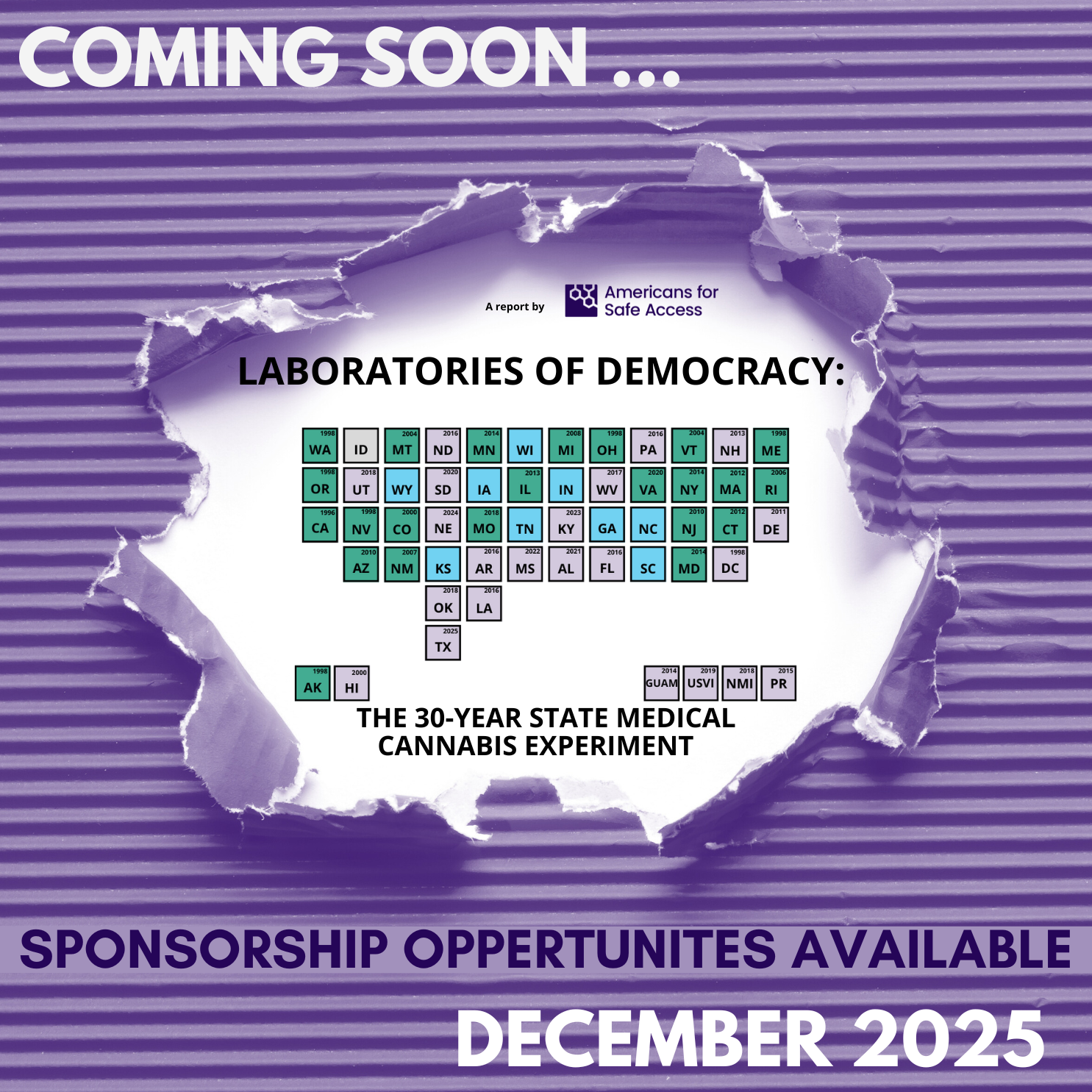 For a decade, Americans for Safe Access (ASA) published its annual State of the States report—the most comprehensive evaluation of medical cannabis programs in the U.S. Each edition included report cards grading every state, territory, and D.C., along with detailed policy recommendations. These reports provided lawmakers, regulators, and advocates with a roadmap for improvement, helping to secure more than 800 changes in laws and regulations nationwide. By 2023, however, the data revealed a troubling trend: while states continued to pass new laws, meaningful patient-focused improvements had stalled, and in many states, protections were rolled back as medical programs were absorbed into adult-use systems. This underscored what ASA has always known: lasting progress requires federal reform.
We are now at a crossroads. Every state but Idaho has enacted some form of medical cannabis access, and a backlash against adult-use markets is growing. For medical programs to continue serving patients, they must evolve—and that evolution demands changes in federal law. The FDA’s 2023 finding that cannabis has “currently accepted medical use” was a critical milestone, but it also exposed one of the barriers that initially drove advocates to the states: the absence of a regulatory pathway for complex botanical medicines.
ASA’s proposed Medical Cannabis and Cannabinoid Act (MCCA) offers that pathway. The legislation would harmonize safety, access, and research standards nationwide, place cannabis in a new Schedule VI, and establish a dedicated Office of Medical Cannabis & Cannabinoid Control under HHS. A federal medical cannabis program does not mean starting from scratch. As outlined in MCCA, it will build on the progress achieved in state programs, restore patients’ federal rights, allow interstate commerce, and integrate cannabis into U.S. healthcare systems.
The Laboratories of Democracy report reviews thirty years of state experimentation to identify the work that must be incorporated into a federal program, the responsibilities states will retain once national legislation is enacted, what work must still be done, and the best practices worth preserving and scaling. More than analysis, it offers a roadmap for medical cannabis stakeholders to expand patient rights, strengthen safe access, and ensure the United States leads in the next era of cannabinoid medicine—one that will require changes at both the state and federal levels.
THE REPORT WILL PROVIDE
The Laboratories of Democracy report reviews 30 years of state experimentation to identify:
- What must be incorporated into a federal program
- What responsibilities will remain at the state level
- What work must still be done to integrate cannabis into healthcare
- Which best practices are worth preserving and scaling
WHAT’S NEW IN GRADING
ASA has expanded its grading criteria for 2025 to reflect today’s challenges:
- Patient Rights & Civil Protections: ADA accommodations; hospital, assisted living, and hospice access
- Access to Medicine: Retail staff training on cannabis medicines
- Affordability: Workers’ compensation reimbursement
- Health Equity: Accommodations for juvenile patients in schools
- Consumer Protection & Product Safety: Safety protocols, data transparency, reference laboratories, adverse event reporting, expanded recall systems
- Regulation Overkill: Identifying burdensome “plutonium-style” regulations that federal oversight should eliminate
DEEP DIVE TOPICS
The report also examines unresolved issues shaping the future of cannabis in medicine:
- Integration into U.S. Healthcare: Closing gaps in access, guidance, and institutional adoption
- Research Priorities & Investments: Building on existing research and targeted investments
- Healthcare Coverage & Cost Savings: Unlocking insurance coverage and federal savings
- Product Safety & Advanced Agriculture: Standardizing transparency and oversight
- Patient Access Post-Prohibition: Establishing best practices for hospitals, hospices, and employment policies
- Parental Rights & Child Protective Services: Protecting families from punitive actions
- Drug Testing & DUI: Modernizing impairment standards
- Home Cultivation: Preserving patient autonomy under federal law
- Medical Professional Education: Integrating cannabis into curricula and continuing education
- Medical Cannabis Market Financial Stress Test: Financial health of U.S. medical cannabis companies and implications for patient access
- Global Market: Preparing U.S. companies to compete internationally
FROM PATCHWORK TO FRAMEWORK
Taken together, these deep dives reinforce the central message of the Laboratories of Democracy report: the past thirty years of state experimentation have provided a wealth of data, models, and lessons, but without federal action, their impact will remain limited. The success of medical cannabis in the states proves what is possible, but scaling that success requires moving beyond patchwork laws and fragmented protections.
There is no denying the state-based experiment worked—for some. Millions of patients have benefitted, and innovative policies have shown what a patient-centered program can look like. But the benefits remain uneven, and the erosion of medical focus under adult-use threatens to roll back hard-won progress. The time has come to ensure those victories are not lost but built upon. The choice before us is stark: let thirty years of patient-led progress wither under neglect, or use it as the foundation for a new era in medicine.
Make a donation or sponsor the report.
If you appreciate ASA's work, sign up to get alerts and updates and make a donation to support ASA's vital mission.

Share this page