|
On April 28, 2026, the Department of Justice issued a final order placing FDA-approved marijuana products and marijuana products regulated by qualifying state medical cannabis licenses into Schedule III of the Controlled Substances Act. DOJ also announced steps the DEA has taken to expedite a separate process to consider broader marijuana rescheduling from Schedule I to Schedule III. That administrative hearing is scheduled to begin on June 29, 2026. These actions were taken in response to President Trump’s December 18, 2025, Executive Order, “Increasing Medical Marijuana and Cannabidiol Research.” That order directed the Attorney General to take all necessary steps to complete the process of rescheduling marijuana to Schedule III of the Controlled Substances Act “in the most expeditious manner” consistent with federal law, including 21 U.S.C. § 811(d). |
WHAT THE DOJ ORDER DOES
|
The order moves certain medical cannabis products from Schedule I to Schedule III. This includes FDA-approved marijuana products and marijuana products covered by qualifying state medical cannabis licenses. The order also recognizes that state medical cannabis programs are part of the medical access landscape. State systems already regulate patient access, licensing, dispensing, labeling, packaging, security, disposal, and recordkeeping. The order relies on this existing state infrastructure to promote medical benefits and avoid unnecessary disruption to patients and state systems. The order recognizes medical cannabis patient registration as equivalent to a prescription. |
WHAT THIS MEANS FOR
Patients: |
For medical cannabis patients, this is federal recognition of the medical value of cannabis. That recognition is more than a feel-good moment. It gives patients in states with medical cannabis programs a new legal platform for federal rights, protected access, and integration of medical cannabis into U.S. healthcare systems.
For state-authorized patients, this means advocates now have a stronger basis to assert:
- rights and protections under the Americans with Disabilities Act, the Fair Housing Act, and Section 504 of the Rehabilitation Act;
- protections against being denied housing, employment, healthcare, or reasonable accommodation solely because of patient status;
- protections against being treated as criminals for possessing state-authorized medical cannabis;
- protections for parents and caregivers whose medical cannabis status has been used against them;
- protections for patients in federally subsidized housing, healthcare settings, federal workplaces, veterans’ care, and other federal systems.
This does not mean every policy has already been updated. It means the legal premise has changed. Federal agencies now need to bring their policies into alignment with the recognition that qualifying medical cannabis is legitimate medicine.
Medical Cannabis Businesses: |
The order creates a federal registration process for state-licensed medical cannabis manufacturers, distributors, and dispensers. State licensees seeking federal registration may submit their state credentials as evidence of state-law authorization. Applications submitted within 60 days of publication are expected to receive expedited review, with review completed within six months.
NOTE: The order says that the Administrator must grant registration unless doing so would be inconsistent with the public interest under the 21 U.S.C. § 823 factors or with the requirements of the Single Convention. More to unpack here, but the most concerning provision is: “(4) prior conviction record of applicant under Federal or State laws relating to the manufacture, distribution, or dispensing of such substances.”
The order also creates a purchase-and-resale mechanism to address international treaty requirements. DEA licensees will sell marijuana crops to the DEA and then purchase them back from the DEA to fulfill those requirements. Registered manufacturers must store marijuana crops in a facility to which DEA maintains access until the transaction is complete.
The order also removes the Section 280E tax burden for state-licensed medical marijuana businesses, and Treasury has announced forthcoming guidance on the final order.
(That business guidance is important, but patients need the same urgency from federal agencies on access and civil rights protections.)
Researchers: |
The order may also lower barriers for research. Researchers registered to conduct marijuana research may be able to obtain marijuana from DEA-registered state licensees for scientific research without facing civil or criminal liability under the Controlled Substances Act solely because the source is state-licensed.
Human research will still need to comply with applicable FDA requirements.
WHAT THE DOJ ORDER DOES NOT DO
|
The order does not
For patients, the order does not:
IMPORTANT NOTE: Patients now have a stronger federal-rights argument, but federal agencies still need to update policies and issue guidance so that patients are not forced to fight discrimination one case at a time. None of these protections apply to patients who are not registered in a state program. |
WHAT HAPPENS NEXT: UNKNOWNS
| This order is a major federal recognition of medical cannabis, but many practical, legal, and political questions remain unresolved. ASA will continue tracking these issues as agencies issue guidance, courts respond, Congress acts, and state programs evaluate implementation. |
Legal Challenges:
The order is likely to face legal scrutiny. Questions may arise about the DOJ’s use of 21 U.S.C. § 811(d), the treaty-based scheduling pathway, the scope of the Attorney General’s authority, the treatment of state medical cannabis licensees, and whether the order properly bypassed ordinary notice-and-comment procedures. 21 U.S.C. § 811 — Authority and Criteria for Classification of Substances
There may also be challenges related to how the order treats state-licensed medical cannabis, how the DEA implements the registration process, whether the purchase-and-resale structure satisfies international treaty obligations, and whether federal agencies can or must update civil rights, housing, employment, healthcare, and veterans’ policies in response. Until courts weigh in — or litigation is resolved — some parts of implementation may remain uncertain.
Patient Rights Enforcement:The biggest unknown is whether federal recognition will translate into real-world protection for patients. Rights do not enforce themselves. Even if patients now have stronger protections under federal law, agencies, employers, landlords, hospitals, and other institutions may not update their policies unless directed to do so by the President, Congress, or the courts. |
State Legislative Actions:
States may also need to act to update statutes, regulations, licensing rules, patient protections, product definitions, reporting systems, or enforcement policies to align with the new Schedule III medical cannabis pathway. Key state-level questions include whether medical cannabis laws need amendments to preserve patient access, whether state licensees must apply for DEA registration, how states will coordinate with the DEA, whether state certifications or registry cards will be treated as sufficient documentation, and whether state protections for employment, housing, healthcare, parental rights, organ transplants, and professional licensing need to be strengthened.
In states without medical cannabis programs, state lawmakers establish a pathway for patients to have access to medical cannabis.
Interstate Commerce and Patient Travel:The order does not clearly authorize interstate commerce between state medical cannabis programs. It addresses import/export permits and federal registration, but it does not clearly state that medical cannabis products may move freely across state lines. Patients should also not assume they can travel freely from state to state with their medicine. State laws, federal property rules, transportation rules, and DEA guidance will still matter. This is an area where Congress or federal agencies need to provide clearer direction. |
Ongoing:
Patients, caregivers, and advocates should document and report discrimination after April 28. ASA will use these reports to push federal agencies to update policies so patients are not forced to fight housing, healthcare, employment, veterans’ services, and disability discrimination one case at a time. Report Medical Cannabis Discrimination now!
WHAT HAPPENS NEXT: PATIENT ADVOCACY
|
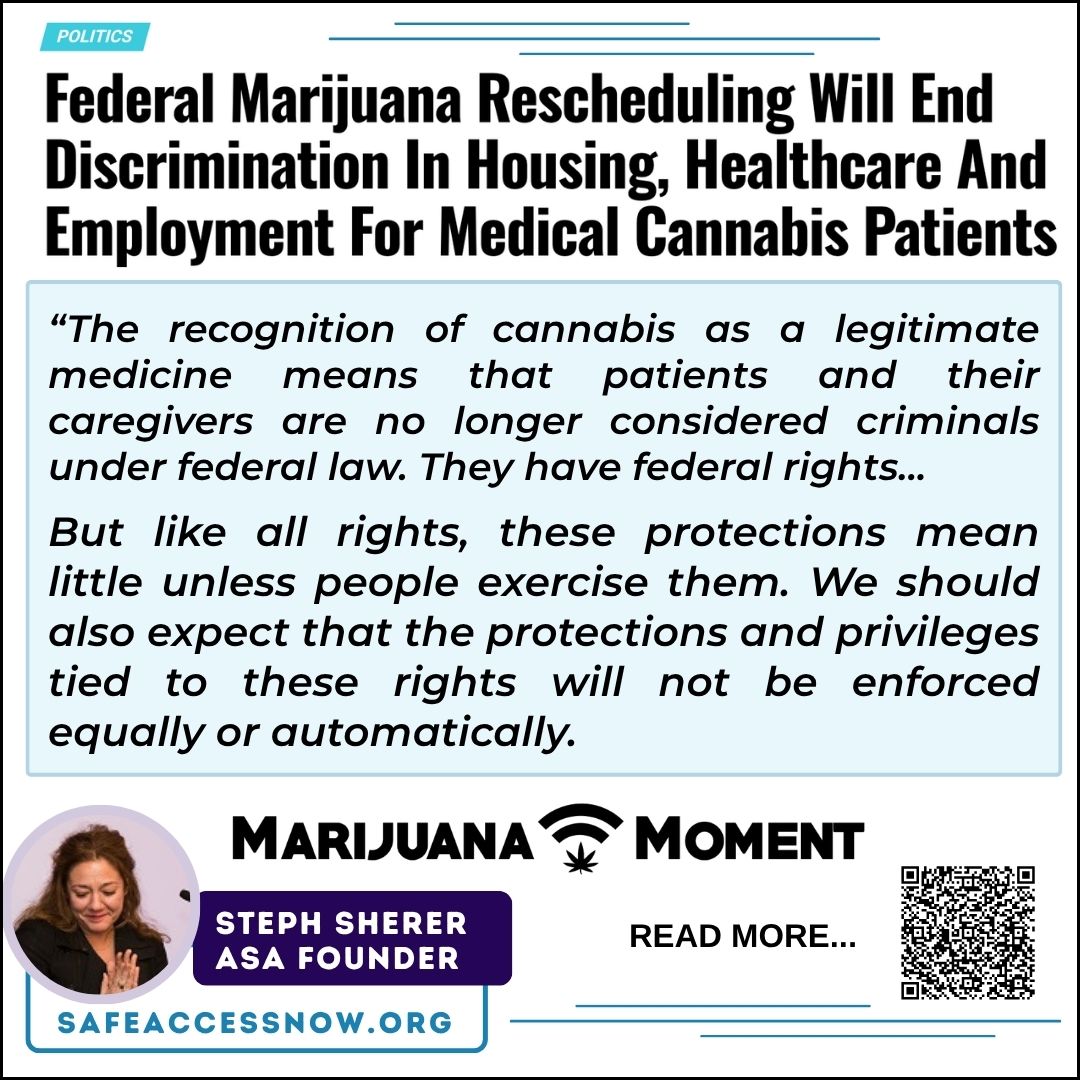
The next phase of advocacy starts now. The recognition of cannabis as a legitimate medicine means patients and caregivers participating in state medical cannabis programs should no longer be treated as criminals under federal law. They have federal rights. Those rights matter in housing, employment, healthcare, veterans’ care, federally assisted housing, federal workplaces, and military systems. But like all rights, these protections mean little unless people exercise them. We should expect that the protections and privileges tied to these rights will not be enforced equally or automatically. Continued patient engagement and advocacy will remain essential until these rights are expressly restored and every patient, regardless of ZIP code or income, has safe and legal access to cannabis medicines. ASA will continue to push federal agencies to update their policies so patients are not left to fight discrimination one case at a time. We will also continue fighting for a national medical cannabis program that protects access, supports research, and integrates medical cannabis into healthcare. |
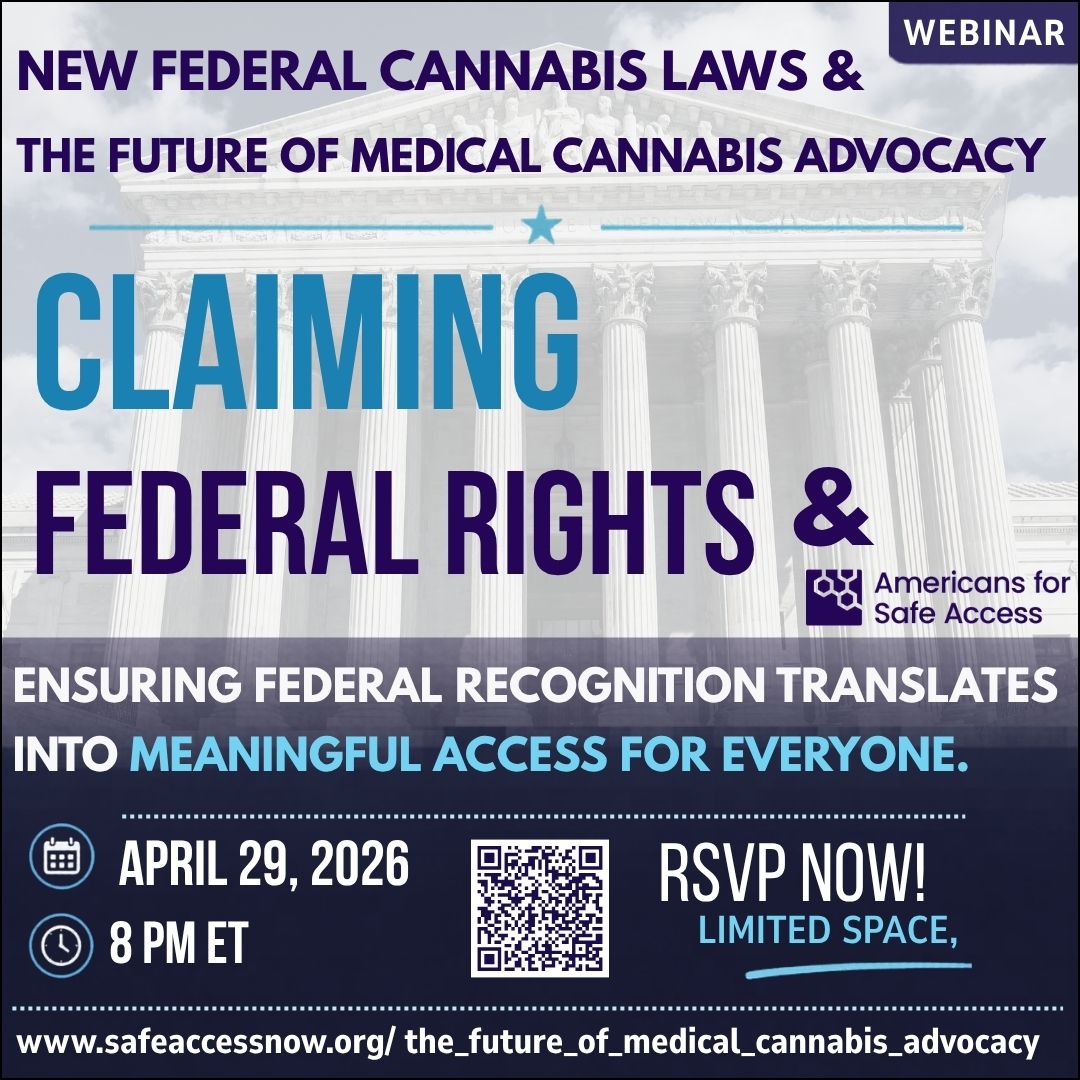
Watch ASA's April 29, 2026, webinar: "New Federal Cannabis Laws & The Future of Medical Cannabis Advocacy," where we broke down the new federal cannabis laws, expected challenges, what they mean for medical cannabis patients, and what comes next for patient advocates. This webinar will help advocates understand the new federal landscape and prepare for Act 2 of the medical cannabis movement: protecting patients, restoring rights, and ensuring federal recognition translates into meaningful access.
ASA is calling on patients, caregivers, healthcare providers, and advocates to stay engaged, become members, and be ready to mobilize. Patients must be front and center as federal cannabis policy continues to evolve.
The federal government has recognized cannabis as medicine. Now it must work with patients to make that recognition meaningful.
If you appreciate ASA's work, join now to become a part of the movement & sign up to get ASA updates

Share this page