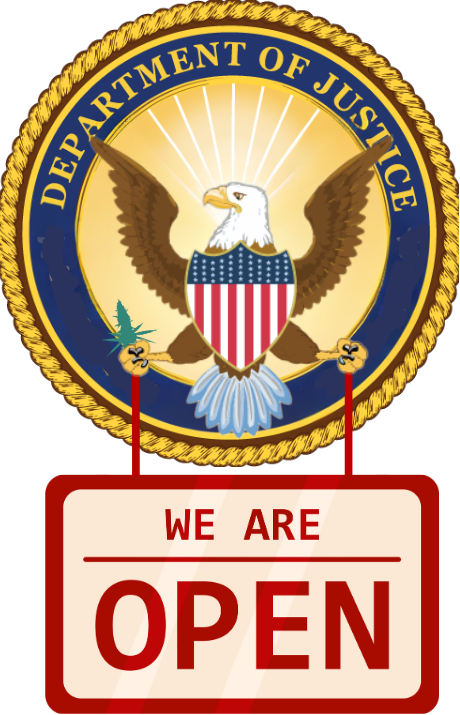
 The federal government may have slowed down, but the real showdown on cannabis policy is just beginning.
SHUTDOWN REALITY CHECK
Even with “shutdown mode” engaged, about 90% of the Department of Justice (DOJ) remains operational. That includes the DEA, FBI, and U.S. Attorneys — all still active under “emergency” exemptions for “safety of human life or the protection of property.”
A SHUTDOWN DOESN’T STOP THIS ADMINISTRATION FROM MAKING MOVES ON CANNABIS SCHEDULING.
It has been almost two months since President Trump told reporters that his administration would be making a “determination over the next — I would say over the next few weeks” on cannabis scheduling. Yet everyone involved in the next steps of that determination is still clocking in for work during the shutdown.
Speculation about Trump’s cannabis scheduling plans made its way back into headlines last week after the President posted a video about CBD on social media. Most predictions about his policy intentions for the future of cannabis are pieced together from offhand comments. So far, nothing ties the President or his administration to making a decision anytime soon — and under the current political landscape, he has little incentive to do so.
Consider this: On one side of the debate, Trump is hearing from the anti-cannabis lobby (and even some cannabis advocates) who want cannabis to remain in Schedule I. They’re amplifying “Big Marijuana” narratives and focusing on how rescheduling might affect business and public health. Groups like Smart Approaches to Marijuana and The Heritage Foundation (a key Project 2025 contributor) have led aggressive campaigns pressuring Trump to oppose rescheduling.
These groups successfully weaponized messaging from parts of the cannabis business community, claiming that Biden’s scheduling review was a reelection stunt — reigniting partisan divisions around cannabis policy that had been fading for years.
That strategy has paid off. The Senators and Representatives leading these anti-rescheduling campaigns are now in key leadership positions the President needs to move his agenda through Congress. Among them:
- Sen. John Thune (R-SD) – Senate Majority Leader
- Sen. Shelley Moore Capito (R-WV) – GOP Policy Committee Chair
- Sen. James Lankford (R-OK) – GOP Policy Committee Vice-Chair
- Sen. Jerry Moran (R-KS) – Chair, CJS Appropriations
- Rep. Hal Rogers (R-KY) – Chair, House Appropriations
- Rep. Andy Harris (R-MD) – Chair, Agriculture Appropriations
- Rep. Robert Aderholt (R-AL) – Chair, HHS Appropriations
All are staunch opponents of changing the federal scheduling of cannabis.

On the other hand, the President only needs to make vague comments or post one uncaptioned image on social media to earn praise from the pro-cannabis community. When a single Truth Social post of a CBD video — shared without a comment, link, or even a photo — can send cannabis stocks soaring, he can see that doing very little can still have a big impact.
So, when weighing a path forward, the President can see that appeasing the anti-cannabis lobby requires him to do nothing, and saying very little seems to appease cannabis businesses.
A SHUTDOWN DOESN’T STOP THIS ADMINISTRATION FROM MOVING ON FEDERAL INTERFERENCE
The “China Cannabis” Narrative & the RICO Threat
On September 18, the Subcommittee on Oversight, Investigations, and Accountability held a hearing titled:
“Invasion of the Homeland: How China is Using Illegal Marijuana to Build a Criminal Network Across America.”
Chairman Josh Brecheen (R-OK) declared Chinese-linked cannabis farms a national security threat, calling for a RICO-powered federal task force to “confront Chinese government conspiracy.”
One of the witnesses? Paul Larkin, Senior Legal Research Fellow at The Heritage Foundation — and a key contributor to Project 2025.
 Trump may claim he hasn’t read Project 2025, but his administration is using it as a policy checklist. The plan lays out a sweeping “law and order” agenda that could easily be weaponized against state-legal cannabis programs.
Here are just a few excerpts:
“The DOJ can play a critical agenda-setting role.” (p. 548)
“Rigorously prosecute interstate drug activity… including simple possession.” (p. 554)
“Aggressively deploy the Racketeer Influenced and Corrupt Organizations Act (RICO).” (p. 555)
If enacted, these directives could reignite federal crackdowns on patients, providers, and programs — under the guise of “national security.”
WHEN THE SHUTDOWN ENDS: THE APPROPRIATIONS BATTLE BEGINS (AGAIN)
A continuing resolution of sorts will end the shutdown. The next phase of this fight will unfold wherever the FY2026 appropriations process, particularly within the Commerce, Justice, Science (CJS), and Agriculture (AG) bills. These bills determine whether medical cannabis programs remain protected or vulnerable to renewed federal interference.
The longest federal shutdown in U.S. history was only 35 days, so don’t get too comfortable.
-
Add Nebraska to Section 529(a)
Nebraska legalized medical cannabis in 2024, and should now be explicitly protected under Section 529(a). -
Remove Section 529(b)
This new section reintroduces federal penalties for cannabis activity near schools or housing — even in state-legal programs. It threatens to undermine a decade of bipartisan protections for patients and providers. -
Remove Section 607
This section blocks cannabis rescheduling — effectively halting the science-based review process that has been underway since 2022.
Why it matters: Since 2014, the CJS Amendment has shielded medical cannabis patients and providers from DOJ prosecution. Rolling it back now could endanger access for more than six million Americans.
-
Clarify Rules for “Intermediate Hemp Extract”
Congress should codify clear definitions for work-in-progress hemp (WIP) to protect compliant processors and prevent unnecessary DEA enforcement. -
Reject Misleading Report Language
Proposed report language attacking the FDA’s 2023 cannabis scheduling review is based on a misreading of the law — and could set back science by decades. The DEA’s “five-factor CAMU test” is an invented barrier, not a statutory requirement. -
Require FDA Labeling Standards for Hemp-Derived Products
The FDA should require basic labeling for all CBD and hemp products, including source disclosure, safety statements, and batch tracking. -
Direct FDA to Use Real-World Evidence (RWE)
ASA recommends directing the FDA to use its existing RWE framework to collect national data on medical cannabis use, patient outcomes, and education gaps.
-
Retain Section 421
Prevents the VA from punishing providers who discuss or document medical cannabis use. -
Add “Medical Cannabis Use” to VA Medical Records
Veterans’ cannabis use should be documented like any other medication. -
Commission a VHA Report on Medical Cannabis Integration
The VA should evaluate cost savings and clinical outcomes from allowing physicians to use cannabis as part of treatment plans.
Why it matters: 22% of veterans report using medical cannabis, yet VA providers are still prohibited from recommending or discussing it.
Cannabis medicines have been shown to improve quality of life for patients with chronic pain, PTSD, cancer-related symptoms, and more — findings echoed by HHS, FDA, NIH, and the National Academies of Science.
ASA recommends that HHS:
- Add “medical cannabis use” to federal health intake and EMR systems.
- Direct CMS to study cost savings and coverage models for medical cannabis.
Older adults — the fastest-growing group of medical cannabis patients — deserve safe, affordable access through the healthcare systems they’ve paid into.
THE BOTTOM LINE: NO TIME TO SLOW DOWN
Even in a shutdown, the machinery of cannabis policy keeps turning — and those steering it aren’t waiting for patients to catch up.
This is the moment to show up, speak out, and secure the future of medical cannabis in America.
Will you show up for the showdown during — and after — the shutdown?
You can start by joining us at ASA’s Fall 2025 Member Meeting to learn how to take action tonight, Oct 8th
RSVP Now!
And please contact your Federal Reps today!

Share this page