Scientists, Clinicians & Health Organizations Warn Marijuana Stigma Is Leaving a Gap in Nutrition Education
New expert guidance urges HHS and medical schools to integrate endocannabinoid system science as 76 institutions expand nutrition education to address chronic disease this fall

PRESS BRIEFING TODAY 11:00 am ET: RSVP
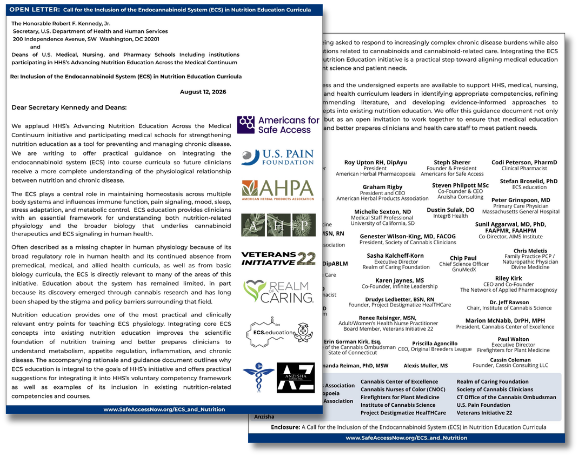
WASHINGTON, D.C. - Americans for Safe Access (ASA), joined by scientists, clinicians, educators, patient advocates, and health organizations, today released an open letter and practical guidance urging the U.S. Department of Health and Human Services (HHS) and medical schools to include the endocannabinoid system (ECS) in the nation's expanding medical nutrition education initiative.
According to HHS, diet-related chronic diseases are responsible for nearly 60 percent of U.S. deaths, and an estimated one million Americans die from them each year. HHS has identified limited nutrition education among medical professionals as a gap in the nation's capacity to address chronic disease.
On March 5, 2026, HHS and the U.S. Department of Education launched Advancing Nutrition Education Across the Medical Continuum. HHS cited research finding that 75 percent of U.S. medical schools had no required clinical nutrition coursework and only 14 percent of residency programs required nutrition training. The initiative now includes 76 committed institutions across 36 states, reaching more than 52,000 medical students, with participating schools expanding nutrition education beginning this fall.
The ad-hoc coalition argues that stronger nutrition education should also include the physiological systems through which diet influences chronic disease. The ECS is an endogenous lipid-signaling and homeostatic system involved in fatty-acid metabolism, appetite and energy regulation, inflammation, gut signaling, stress adaptation, metabolic control, immune function, and pain. The guidance identifies the ECS as an important part of the physiological relationship among nutrition, metabolism, and chronic disease.
“HHS is strengthening nutrition education because chronic disease is taking an enormous toll on patients and the healthcare system. If future clinicians are going to understand how nutrition affects chronic disease, they also need the physiological foundation that helps explain that relationship. We are not asking schools to create a cannabis course. We are asking them to teach the physiology,” said Steph Sherer, Founder and President, Americans for Safe Access.
CDC reports that three in four U.S. adults have at least one chronic condition and more than half have two or more. For people managing multiple conditions, polypharmacy can increase risks of adverse drug events, drug interactions, falls, and hospitalization. Adults aged 65 and older make more than 600,000 emergency-department visits each year because of adverse drug events.
“Teaching the endocannabinoid system in medical training will help future physicians better understand a key regulator of human physiology and communicate more clearly with the millions of Americans who use cannabis in one form or another. That knowledge is empowering, practical, and essential to truly informed care, said letter signatory Stephen Dahmer, MD, Director, University of Arizona Andrew Weil Center for Integrative Medicine.
The guidance shows how ECS concepts can be incorporated into existing nutrition, physiology, metabolism, and chronic-disease coursework without creating a stand-alone ECS or cannabis course. It maps suggested content into HHS's 10-domain competency framework and provides teaching examples based on publicly available course structures from Johns Hopkins, Stanford, Penn, Yale, and UC Berkeley. The examples are not official university curricula or endorsements.
“Integrating the ECS into HHS’s Advancing Nutrition Education initiative is a practical step toward aligning medical education more closely with current science and patient needs,” the coalition wrote in its sign-on letter. “We offer this guidance document not only as a recommendation, but as an open invitation to work together to ensure that medical education reflects current science and better prepares clinicians and health care staff to meet patient needs.”
 “The endocannabinoid system may be an important missing link in how we teach the relationship between nutrition and health. Giving clinicians a stronger foundation in ECS science can improve their understanding of how diet, physiology, and disease intersect,” added Codi Peterson, PharmD, Associate Clinical Professor, UC Irvine; Co-Founder, Pharmacists’ Cannabis Coalition of California.
The letter asks HHS and Medical Educators to
-
-
- Include core ECS concepts in HHS's voluntary Medical Education Nutrition Competency Framework.
- Integrate ECS science into existing nutrition, physiology, metabolism, and chronic-disease instruction where it is directly relevant.
- Work with ECS scientists, clinicians, educators, curriculum leaders, and patient experts to develop accurate, evidence-informed teaching materials and implementation strategies.
-
ASA and participating experts are offering to work with HHS, medical, nursing, and pharmacy schools, curriculum leaders, accrediting organizations, and other health-professions education institutions to identify appropriate competencies, refine course content, recommend literature, and support implementation.
“Whether you are training elite athletes or preparing Marines for combat, stress physiology and nutrition are inseparable,” said Steve Philpott, Jr., Co-Founder and CEO, Anzisha Consulting. “The endocannabinoid system is the thread that ties them together, and it has been missing from medical and general biological science education for far too long.”
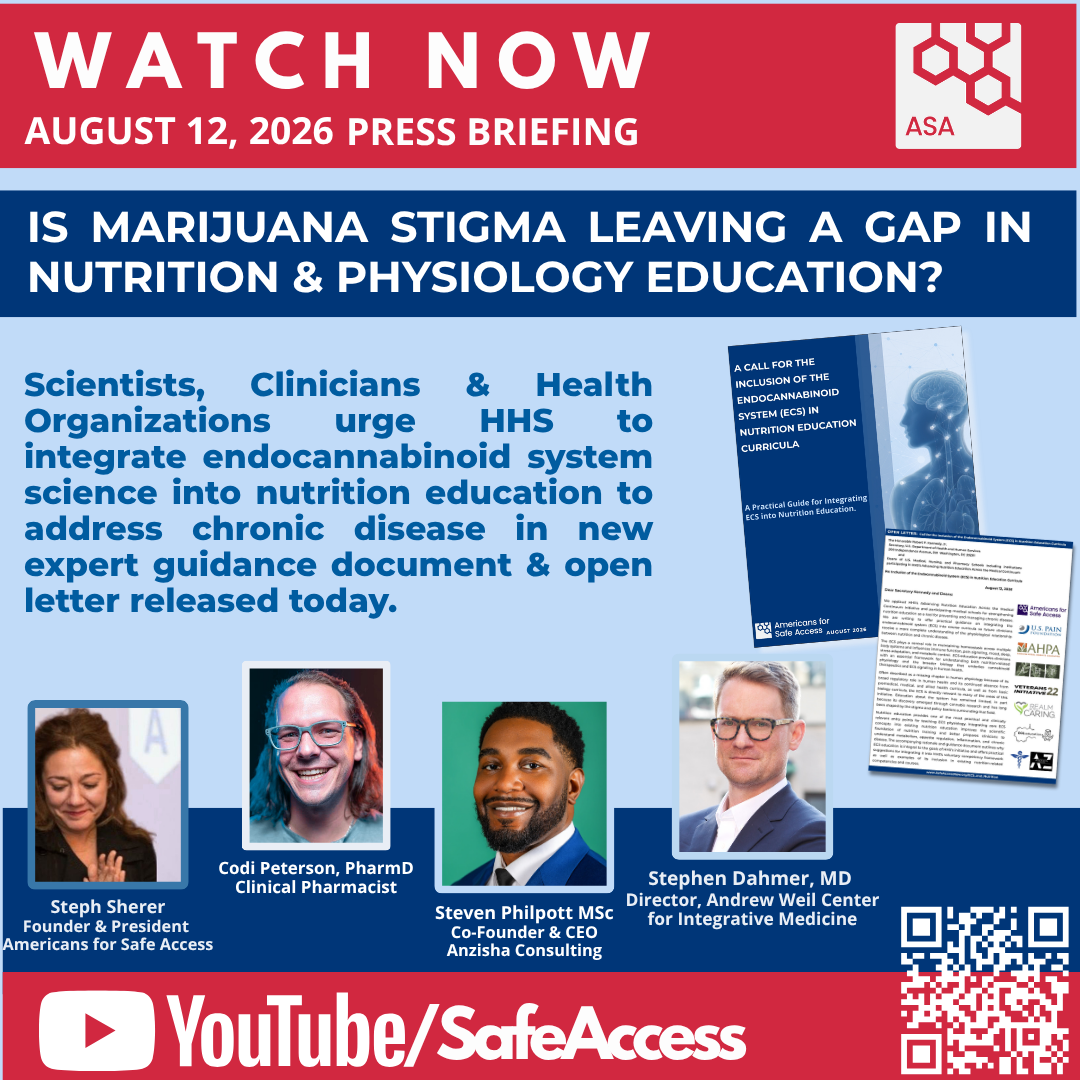
Media Briefing - Today at 11:00 a.m. ET
ASA will hold a media briefing Wednesday, August 12 at 11:00 a.m. ET to discuss the HHS nutrition education initiative, the scientific rationale for ECS education, and practical recommendations for institutions expanding nutrition training this fall.
- Steph Sherer, Founder and President, Americans for Safe Access
- Stephen Dahmer, MD, Director, University of Arizona Andrew Weil Center for Integrative Medicine
- Codi Peterson, PharmD, Associate Clinical Professor, UC Irvine; Co-Founder, Pharmacists’ Cannabis Coalition of California
- Steve Philpott, Jr., Educator, Writer, Researcher; Co-Founder and CEO, Anzisha Consulting
Media Contact: Steph Sherer: [email protected]
Materials:
GUIDANCE (available at noon ET)
TAKE ACTION: SIGN THE LETTER TO HHS
About the Speakers
Steph Sherer, Founder and President, Americans for Safe Access. Sherer founded ASA in 2002 and has spent more than two decades leading medical cannabis policy, safety, research, and patient-access efforts.
Stephen Dahmer, MD, Director, University of Arizona Andrew Weil Center for Integrative Medicine. Dr. Dahmer is triple board-certified in Family, Integrative, and Lifestyle Medicine and focuses on whole-person care, medical education, and integrative therapies.
Codi Peterson, PharmD, Associate Clinical Professor, UC Irvine; Co-Founder, Pharmacists’ Cannabis Coalition of California. Dr. Peterson is a pediatric and emergency-department pharmacist whose work focuses on cannabis pharmacology, ECS science, and clinician education.
Steve Philpott, Jr., Educator, Writer, Researcher; Co-Founder and CEO, Anzisha Consulting. Philpott is a U.S. Marine Corps veteran and educator applying ECS and cannabis science to athletics, performance, recovery, and high-stress populations.
About Americans for Safe Access. Founded in 2002, Americans for Safe Access (ASA) is a national organization of patients, medical professionals, scientists, providers, and concerned citizens promoting safe and legal access to cannabis for therapeutic use and research. Learn more at SafeAccessNow.org.
###
If you appreciate ASA's work, sign up to get alerts and updates and make a donation to support ASA's vital mission.

Share this page